


© 2025 Aruba Intelligence - Quantum Quorum Media


No Warning and No Media Briefing: CMO Aruba’s Public Crisis Communication Failed Completely
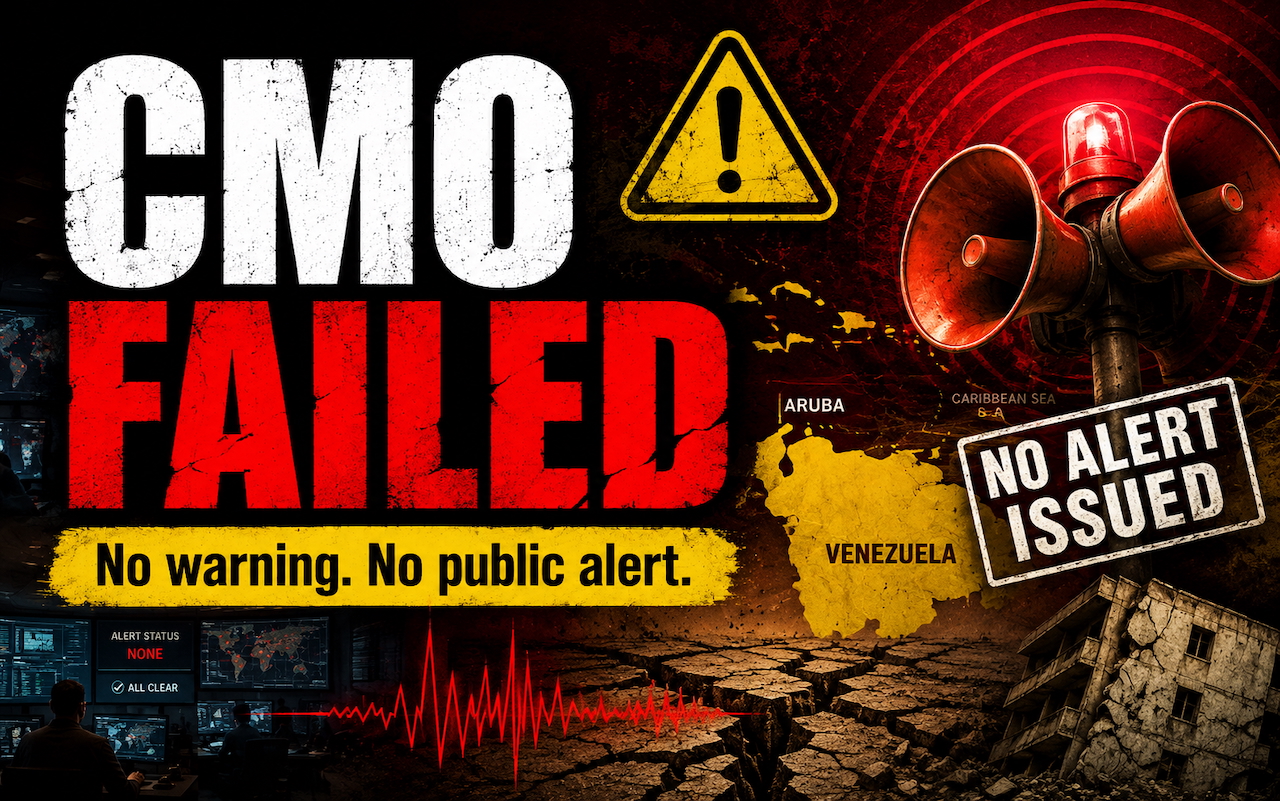
ORANJESTAD — While Venezuela was struck by two extremely powerful earthquakes on Wednesday evening and Aruba was included in an international assessment of a possible tsunami threat, no public warning was issued by the Crisis Management Office Aruba. There was no immediate safety notice, no situation update, no press release and no proactive information for the media.
Journalists had to go to the CMO office themselves to obtain information and clarification. This is the opposite of how crisis communication should function during a rapidly developing emergency. The responsible authority should have immediately distributed verified information to both the media and the public.
During the critical initial period, there was literally no visible communication from Aruba’s crisis-management authority.
At the level at which the warning system should have served the public and the press, this amounted to a complete communication failure.
Two powerful earthquakes and regional uncertainty
Venezuela was struck by two major earthquakes within less than one minute on Wednesday evening. International seismological data listed preliminary magnitudes of 7.2 and 7.5.
The earthquakes caused extensive damage in Caracas and other parts of Venezuela. Buildings and walls collapsed, residents evacuated their homes, and emergency services began search-and-rescue operations.
Shortly after the earthquakes, international authorities assessed whether dangerous tsunami waves could reach parts of the region. Venezuela, Aruba, Curaçao and Bonaire were included in that regional assessment.
The threat was later withdrawn. During the period before that withdrawal, however, uncertainty remained regarding the possible risk to the ABC islands.
Bonaire did warn its population
The Public Entity Bonaire issued a public message about the earthquake and the possible regional tsunami threat. Residents therefore received at least official confirmation that the authorities were aware of the situation, were monitoring developments and would provide further information.
That is a fundamental component of crisis communication. An initial message does not need to contain an evacuation order. It can simply confirm that an event has occurred, that possible consequences are being assessed and that the public should continue to follow official channels.
Bonaire demonstrated that timely communication was possible, even while the international assessment was still underway.
In Aruba, some residents received an automated warning through the Android Earthquake Alerts System. That alert came from Google, however, and not from an Aruban government authority.
The result was that foreign technological systems and authorities on another island communicated visibly before Aruba’s own crisis-management organisation did.
Media had to go to CMO themselves
According to Amigoe Aruba’s own observations, no warning, media bulletin or operational explanation was received from CMO through the usual communication channels.
Instead of CMO actively distributing information to news organisations, journalists had to go to the organisation’s office themselves to determine what was happening and whether Aruba faced any danger.
This represents a fundamental reversal of responsibilities.
During a potential emergency, a crisis-management authority should not wait for journalists to appear physically at its office. CMO should maintain updated media contact lists, direct communication channels and pre-approved message formats that allow an initial official statement to be distributed within minutes.
The media are not outsiders who should be required to search for information during such circumstances. They form an essential part of the public warning chain and can rapidly distribute official information to large sections of the population.
When CMO fails to provide that information proactively, an information vacuum develops in which social media posts, rumours, foreign warnings and unverified videos take over public communication.
Literally no warning
During the relevant period, no message was identified on CMO’s publicly monitored channels stating:
- that two powerful earthquakes had struck Venezuela;
- that Aruba had been included in a regional tsunami assessment;
- that Aruban authorities were monitoring the situation;
- that residents should remain calm;
- whether people should stay away from the coast or whether no action was necessary;
- where official follow-up information would be published.
There was also no visible communication to newsrooms containing background information, safety instructions, the name of an official spokesperson or a scheduled time for the next update.
For the public and the media, there was literally nothing.
Early Warning System failed its practical test
The Government of Aruba officially presented the Early Warning System in March 2025. The system was intended to improve Aruba’s preparedness for natural disasters and to provide early warnings to residents, including through the use of sirens.
As far as could be publicly established, no siren alarm was activated during the earthquakes in Venezuela. That may be understandable if no evacuation or immediate physical danger was confirmed.
The absence of sirens, however, does not explain why every other visible form of crisis communication was also absent.
A warning system consists of more than sirens. It includes monitoring, internal assessment, decision-making, press communication, social-media updates, website notices, direct alerts and instructions to the public.
When all these visible components fail to provide information during a genuine regional threat, the system cannot be regarded as successful from the public’s perspective.
This event constituted a real-world test. In the areas of public warning and media communication, Aruba did not pass that test.
No proof of complete technical failure
Based on publicly available information, it cannot be established that all of CMO’s internal or technical systems failed.
Such a conclusion would require examination of communication logs, internal alerts, decision records, operational protocols and technical status reports.
It is possible that CMO received the international warnings and internally concluded that neither sirens nor an evacuation were necessary. Even in that scenario, however, the question remains why the public and the media were not immediately informed of that assessment.
The confirmed failure therefore concerns, at minimum, the entire visible communication chain: from the receipt of international information to the timely notification of the press and the public.
Absence of danger afterward does not justify silence
The fact that no dangerous tsunami ultimately reached Aruba does not make the initial silence less serious.
A warning system is not assessed solely on the basis of the final outcome. It is assessed by the speed, reliability and clarity with which authorities communicate during uncertainty.
At the time of the first international notices, it was not yet known how the situation would develop. That was precisely the moment when residents required an official message from their own government.
The fact that no tsunami occurred cannot be used afterward to justify the absence of communication while the risk was still being assessed.
CMO must provide full accountability
CMO should publicly explain:
- when the first international warning was received;
- which officials were informed;
- what risk assessment was conducted for Aruba;
- why no public message was distributed;
- why no information was sent to news organisations;
- why journalists had to go to the office themselves;
- whether the sirens and digital communication systems were operational;
- which protocol determines when the Early Warning System is activated;
- what immediate improvements will be implemented.
It must also be clarified who held operational and administrative responsibility for the decision not to communicate publicly.
At the time of publication, no substantive explanation from CMO regarding these matters was available.
The conclusion based on the publicly available information is sharp but necessary: parts of the system may have functioned internally, but the public warning and communication chain failed completely. During a serious regional emergency, residents and media received no timely warning, no explanation and no visible leadership from the authority responsible for providing it.