


© 2025 Aruba Intelligence - Quantum Quorum Media


Google warned Aruba within minutes while official Crisis Communication lagged behind
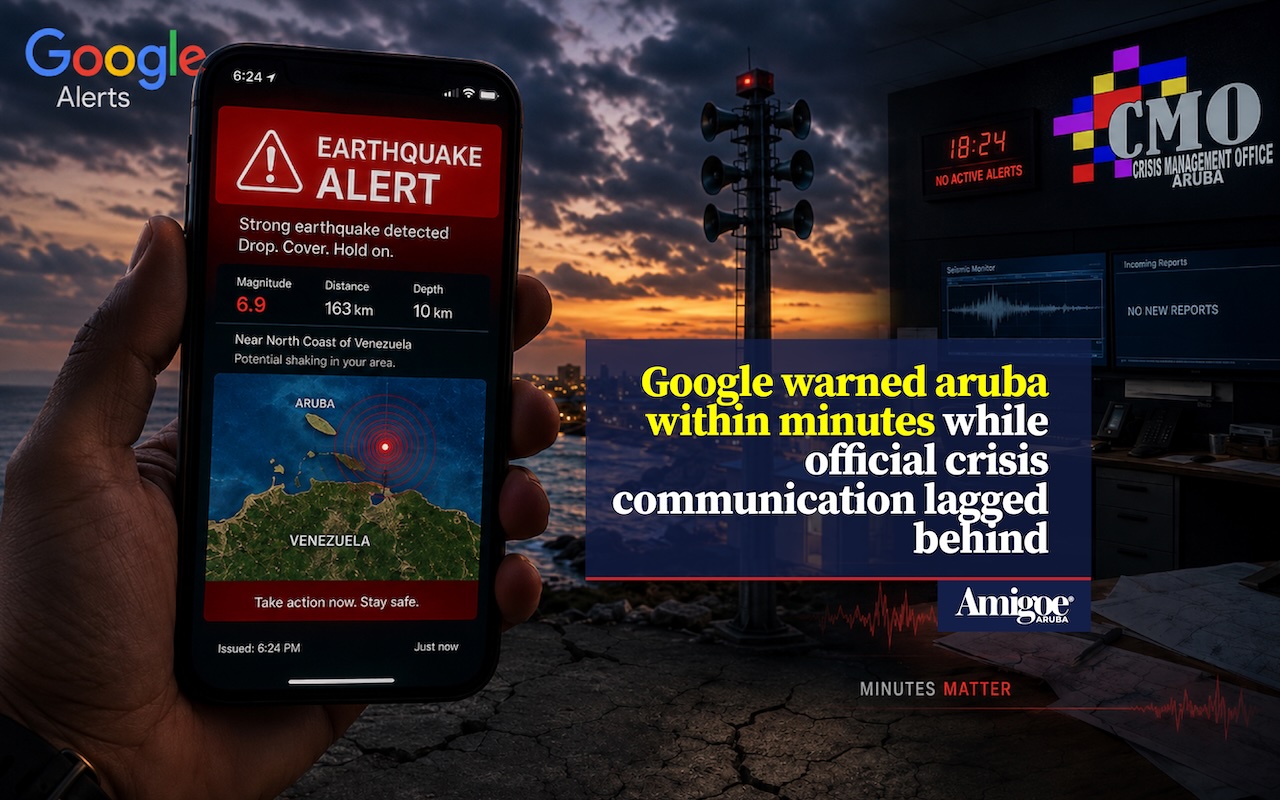
ORANJESTAD — Android users in Aruba received an automated earthquake alert shortly after the powerful earthquakes struck Venezuela. According to reports received by Amigoe Aruba, the warning appeared approximately two minutes after the first earthquake. A global technology-based detection system therefore informed residents almost immediately, while no comparable public warning was visibly issued by Aruba’s Crisis Management Office.
The situation raises a fundamental question: can Aruba safely depend on an official warning chain in which several agencies must first verify information and approve decisions before the public is alerted during a tsunami, earthquake or other rapidly developing emergency?
The comparison between Google and CMO demonstrates that automated technology can operate within minutes, while administrative decision-making may consume valuable time.
Android warning appeared almost immediately
The strongest earthquake near Venezuela was recorded at approximately 6:05 p.m. Aruba time on June 24. Android users then received a notification showing an estimated magnitude, distance, location and safety information.
According to recipients in Aruba, the warning appeared about two minutes after the event.
The exact transmission time could not be independently verified through a publicly accessible Google log. However, the screenshot received by the newsroom confirms that the Android Earthquake Alerts System had quickly identified the earthquake and presented information to users in the region.
The system uses accelerometers built into large numbers of Android phones as a distributed network of small seismic sensors. When several devices simultaneously register similar movements, Google automatically estimates the likely location and magnitude and may send warnings to other phones.
For residents, this meant that information about the earthquake was available before many local and regional authorities had communicated publicly.
First international tsunami information after eight minutes
The Pacific Tsunami Warning Center issued its first regional threat message at 22:13 UTC, corresponding to 6:13 p.m. Aruba time. The second major earthquake occurred at approximately 22:05 UTC.
Approximately eight minutes therefore passed between the earthquake and the first international tsunami threat bulletin.
The bulletin stated that dangerous tsunami waves were possible along coastlines within approximately 300 kilometres of the epicentre. Aruba, Bonaire, Curaçao and Venezuela were explicitly included.
A preliminary arrival time of approximately 6:58 p.m. was calculated for Oranjestad. National authorities were expected to determine the appropriate local warning level and issue instructions to the population.
The international system therefore delivered a formal threat assessment within eight minutes. From that point onward, responsibility for local communication rested with national and island authorities.
Lack of clarity over Aruba’s internal approval process
According to information provided to Amigoe Aruba, activating an official warning in Aruba may require several verification and approval steps between different departments. A process of approximately eight minutes has been mentioned.
No publicly available protocol or operational document was found confirming that this specific period is a standard local requirement.
That distinction is important. The verified eight-minute period concerned the Pacific Tsunami Warning Center, which first had to analyse seismic data and prepare a regional forecast. It has not been publicly established how much additional time Aruba’s internal decision-making process requires after receiving such a warning.
CMO should therefore clarify:
- when the first earthquake notification was received;
- when the international tsunami bulletin arrived;
- which departments had to verify the information;
- who has the authority to activate an alert or siren;
- how long each step normally takes;
- and why no immediate preliminary public notice was issued.
Without these details, it cannot be established whether the system failed technically, was delayed administratively or was intentionally not activated.
Initial information does not need to be an evacuation order
An official authority does not need to activate sirens or order an evacuation immediately after an earthquake is detected. Such far-reaching decisions require reliable assessment.
That does not justify providing no information during the verification period.
CMO could have issued a short preliminary statement within minutes, such as:
“A strong earthquake has struck Venezuela. Possible consequences for Aruba are being assessed. Remain calm and follow official channels. A further update will follow.”
Such a message would not present an unverified conclusion and would not create an unnecessary evacuation. It would, however, demonstrate that the authorities were monitoring the situation and would prevent residents from becoming entirely dependent on social media, foreign websites and private messages.
A clear distinction should therefore be made between:
- an immediate information notice confirming that an incident is being assessed;
- an official warning that danger may be present;
- a concrete instruction, such as staying away from the coast;
- and a siren or evacuation order in the event of confirmed immediate danger.
By defining these levels in advance, the first public message would not need to pass through a lengthy approval process.
Google was faster, but cannot replace the official system
The speed of the Android warning deserves recognition. Google demonstrated that automated detection can reach large groups of people within minutes.
The Android system, however, cannot replace CMO or Aruba’s official Early Warning System.
Google itself states that:
- not every earthquake is detected;
- warnings may arrive before, during or after shaking begins;
- a user may receive an alert without feeling any movement;
- mobile data or Wi-Fi is required;
- location services must be enabled;
- not everyone owns an Android phone;
- and the function is not available in every country or on every device.
The Android Earthquake Alerts System primarily warns of earthquakes. It does not independently determine whether Aruba must evacuate because of a tsunami, chemical incident, explosion, hurricane, flooding or another disaster.
Only the competent local authorities can issue official instructions based on conditions in Aruba.
Not Google or CMO, but Google and CMO
The correct conclusion is therefore not that Aruba should rely solely on Google.
A private technology company can provide rapid supplementary information, but it carries no public-law responsibility for Aruba’s safety. That responsibility remains with the government and the authorised crisis-management organisation.
The incident nevertheless demonstrates that CMO should integrate modern automated systems into its own warning chain.
International standards provide for this through the Common Alerting Protocol. A single validated message can then be distributed simultaneously through:
- mobile warnings;
- cell broadcast;
- sirens;
- radio and television;
- social media;
- government websites;
- tourism networks;
- hotels;
- news organisations;
- and emergency services.
Such a system would reduce the risk that separate departments must repeatedly forward and approve the same message before the public receives any information.
A lengthy approval chain may cost lives
When a tsunami originates nearby, the available response time can be extremely limited. CMO states on its own website that tsunami waves may reach the coast within minutes in certain circumstances.
If international detection already requires eight minutes and a lengthy local verification and approval procedure follows, a substantial part of the available evacuation time could be lost.
Decision-making authority should therefore be established in advance. A 24-hour operational warning point should be authorised to issue an initial message independently when predetermined criteria are met.
Interdepartmental coordination can continue simultaneously. It should not mean that every public message is delayed until each involved authority has separately approved it.
Official responsibility rests with CMO
The Government of Aruba describes CMO as the authority responsible for preparing crisis plans, coordinating between agencies, exchanging relevant information and communicating during crises and disasters.
The Early Warning System was officially inaugurated in March 2025. According to the government, the sirens were intended to provide the first signal to people in threatened areas.
The earthquakes in Venezuela constituted a real-world test. Android users received rapid technical information, while visible official communication from CMO lagged behind.
This does not automatically mean that all internal systems failed. It does mean that the public could not see what CMO knew, what assessment had been made or what instructions applied.
Aruba should conduct and publish a full evaluation
CMO should publish a complete timeline of the events of June 24, including:
- the time of the first automated notification;
- the time at which Meteo Aruba and CMO became aware of the event;
- receipt of the Pacific Tsunami Warning Center bulletin;
- internal communication between the relevant services;
- the moment a decision was taken;
- and the reason why no public warning message was distributed.
Aruba should also establish a clear maximum-response standard between receipt of an international warning and communication with the population.
The purpose of an Early Warning System is not merely to have equipment in place. The system must be demonstrably capable of warning the population quickly, reliably and through multiple channels.
Google showed what automated technology can achieve within minutes. Aruba’s responsibility is now to ensure that its official warning chain becomes visible and operational just as quickly, without sacrificing reliability or proper authority.
At the time of publication, no substantive public explanation had been issued by CMO concerning its exact approval procedure or the time required to activate a warning.