


© 2025 Aruba Intelligence - Quantum Quorum Media


Trump: U.S. Will Temporarily Govern Venezuela After Capture of Maduro
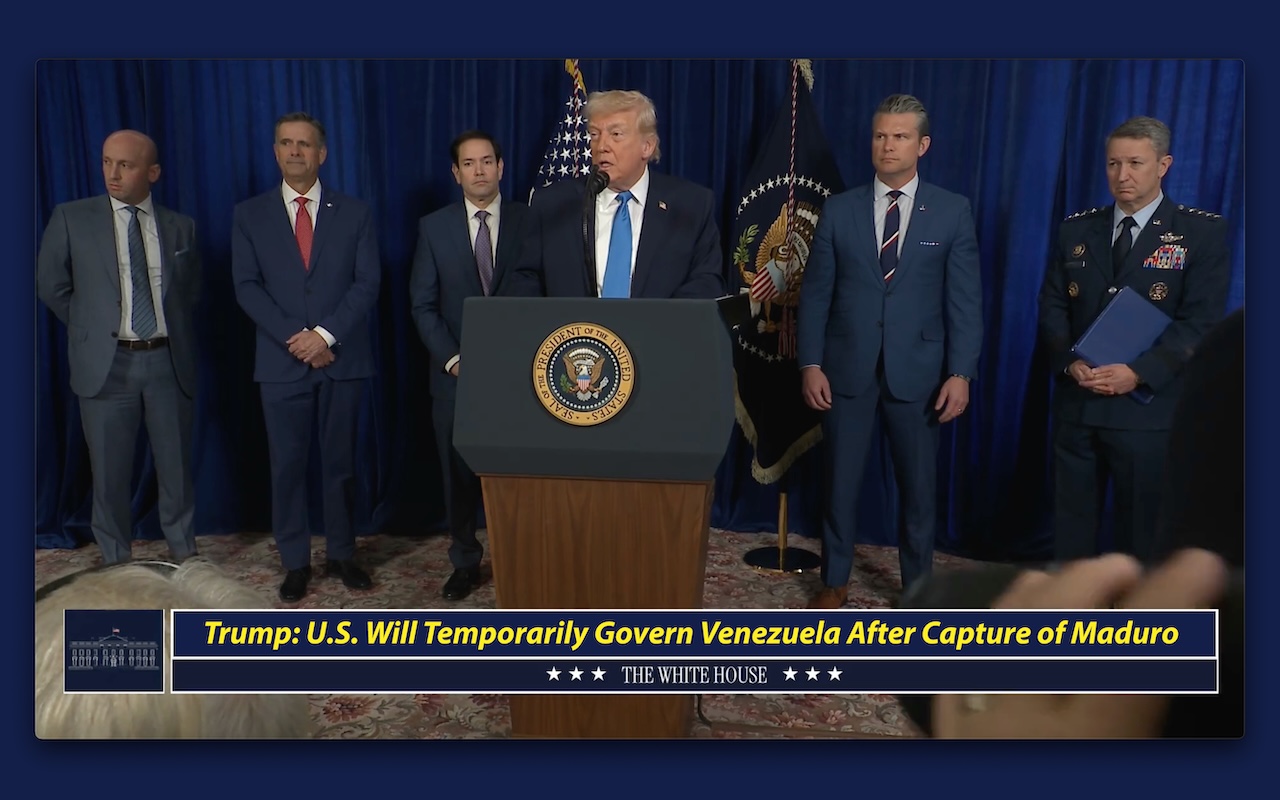
WASHINGTON – January 3, 2026 — U.S. President Donald Trump announced that the United States will temporarily assume control over Venezuela’s governance following the capture of President Nicolás Maduro, pending what he described as a “safe, proper and judicious democratic transition.”
Speaking during a lengthy press conference, Trump said the U.S. would remain in Venezuela to prevent a repeat of what he called decades of failed leadership.
Who will run Venezuela
According to Trump, the United States will oversee Venezuela directly until a transitional authority is established.
“We’re going to run the country until such time as we can do a safe, proper, and judicious transition,” Trump said.
He stated that Washington does not intend to immediately hand power to another Venezuelan faction, arguing that doing so could recreate the conditions that led to Maduro’s rule.
No interim Venezuelan civilian government was named during the press conference.
Oil sector: U.S. companies to rebuild and operate
Trump said Venezuela’s oil industry will be rebuilt by major U.S. energy companies, which he claimed would invest billions of dollars to restore damaged infrastructure.
“We’re going to have our very large United States oil companies go in, spend billions of dollars, fix the badly broken infrastructure, and start making money for the country,” he said.
Who benefits
According to Trump:
- Venezuela would benefit through restored production and revenue
- U.S. oil companies would benefit through contracts and operations
- The United States would benefit strategically by regaining influence in the Western Hemisphere
Trump emphasized that the embargo on Venezuelan oil remains in effect, signaling that exports would remain tightly controlled during the transition.
How the capture was carried out
Trump described the capture of Maduro as a large-scale, multi-domain military operation conducted overnight in Caracas.
Key elements outlined by U.S. officials during the press conference:
- Operation conducted late night / early morning
- Caracas experienced widespread power outages
- Joint effort involving U.S. military and U.S. law enforcement
- Maduro and his wife Cilia Flores were captured together
- No U.S. casualties and no equipment losses
Senior military officials stated that the operation involved:
- More than 150 aircraft
- Coordination across air, land, sea, space, cyber, and intelligence domains
- Extensive use of surveillance, drones, and special operations forces
- Months of intelligence preparation involving the CIA, NSA, and NGA
The mission was identified as “Operation Absolute Resolve.”
Legal outcome
Trump confirmed that Maduro and Flores are indicted in the Southern District of New York on narco-terrorism charges and will be transferred to the United States to stand trial.
“Maduro and his wife will soon face the full might of American justice,” Trump said.
International implications
Trump warned that:
- U.S. forces remain deployed
- A second, larger military operation was prepared but not required
- All Venezuelan political and military leaders remain under notice
“What happened to Maduro can happen to them,” he said.
Context
If implemented as described, this would mark:
- The first direct U.S. administration of a Latin American country in decades
- A major shift in U.S. policy regarding sovereignty and intervention
- A fundamental restructuring of Venezuela’s oil sector under U.S. oversight