


© 2025 Aruba Intelligence - Quantum Quorum Media


Aruba Cracks Down on E-Scooters, But Leaves the Bigger Question Untouched: What About ATVs and UTVs?
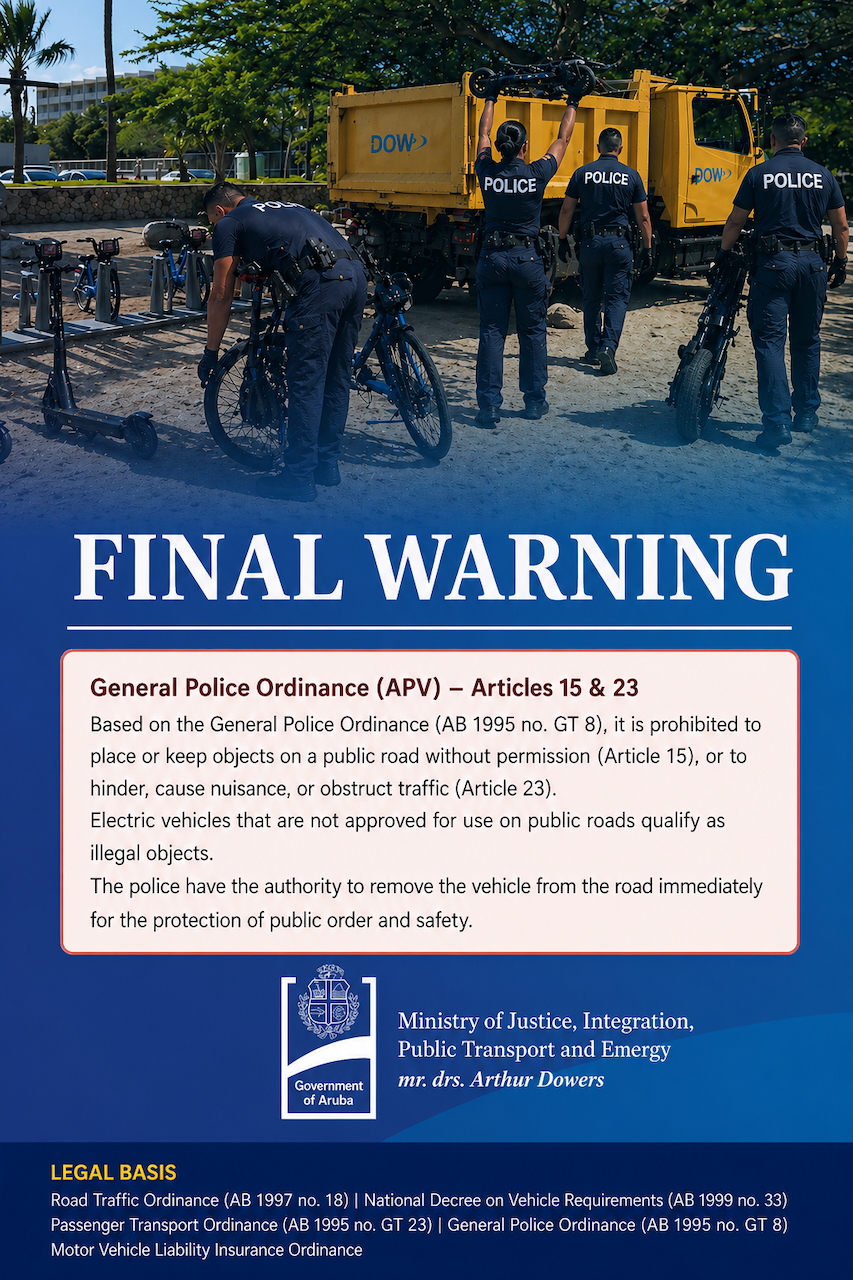
The final warning against electric steps raises uncomfortable questions about selective enforcement
ORANJESTAD—The Government of Aruba has issued a clear final warning against the use and placement of electric steps, e-scooters, e-bikes, and similar vehicles on public roads and public land. In an official notice carrying the title “Ultimo Aviso / Final Warning,” the Ministry of Justice, Integration, Public Transport, and Energy states that the police have authority to remove such vehicles immediately when they are placed on public roads without permission or obstruct public order and traffic.
The legal basis cited includes the General Police Ordinance, the Road Traffic Ordinance, vehicle regulations, public transport legislation, and motor vehicle liability insurance rules. The message is direct: vehicles not legally approved for public-road use may be treated as illegal objects and removed.
But the government’s hard line against e-steps now exposes a deeper contradiction. While small electric vehicles are being targeted with immediate enforcement, the much larger and more environmentally damaging issue of ATVs and UTVs remains only partially addressed.
A fast crackdown on small vehicles
Minister of Justice Arthur Dowers has taken a strict position on electric steps and scooters. According to Antilliaans Dagblad, the government says these vehicles are not allowed on public roads when they do not meet specific legal requirements, including registration, technical approval, insurance, and other conditions.
EA News Aruba reported that Dowers personally inspected the hotel area and concluded that steps placed on public land are illegal and must be removed. The government’s argument is that these vehicles create risks for traffic safety, pedestrians, and public order.
That position may be legally defensible. If a vehicle has no legal classification, no insurance, no inspection, no registration, and no permitted place on the public road, the authorities can reasonably argue that enforcement is necessary.
The problem is not that e-steps are being addressed. The problem is that the same urgency is not visibly applied to ATVs and UTVs.
ATVs and UTVs remain outside the same level of urgency
Aruba.nu reported this week that ATVs and UTVs will not, for now, be placed on the list of prohibited vehicles. According to that report, Minister Dowers has said that these vehicles are not being banned, although stricter enforcement may follow.
That distinction is politically and legally significant. E-steps are being removed because they allegedly create danger and lack a proper legal framework. Yet ATVs and UTVs are far heavier, faster, louder, and more invasive. They are used not only on roads but also near vulnerable natural areas, dirt roads, coastal zones, and landscapes that form part of Aruba’s tourism value.
The government itself has already acknowledged the ATV/UTV problem. In August 2024, the Government of Aruba announced a policy to regulate and reduce the use of ATVs and UTVs. The stated goal was to reduce harm to nature, reduce nuisance for residents, and improve safety for users.
That raises a direct question: if the government already recognized the harmful impact of ATVs and UTVs in 2024, why is the current enforcement campaign focused so sharply on e-steps while ATV and UTV operations remain largely active?
Nature damage cannot be treated as a secondary issue
The environmental concern is not speculative. Aruba’s National Biodiversity Strategy and Action Plan 2024–2030 identifies high-impact recreation, including UTVs and ATVs, as a pressure factor on Aruba’s natural resources. It also refers to off-road driving as part of the broader pressure on the island’s ecosystems.
That makes the issue larger than traffic enforcement. It is about land protection, tourism sustainability, public safety, and equal application of the law.
Electric steps may create risks in urban and hotel areas. But ATVs and UTVs can create risks across a much wider footprint: erosion, dust nuisance, disturbance of natural habitats, unsafe road interaction, damage to fragile terrain, and pressure on areas that are not designed for heavy recreational motorized traffic.
If the government argues that e-steps must be removed because Aruba has no adequate legal framework for them, the public is entitled to ask whether the existing framework for ATVs and UTVs is truly adequate, and whether enforcement is strong enough.
The legal inconsistency
The government’s final warning relies on the principle that public roads and public land cannot be used freely by vehicles that are not properly authorized. That principle should not apply only to the newest or easiest target.
The same questions should be asked of every transport-related activity:
Are the vehicles properly registered?
Are they insured for their actual use?
Are they technically inspected?
Are they permitted to operate in the areas where they are used?
Are tourists properly informed of the risks?
Are operators monitored?
Are environmental restrictions actually enforced?
Are violations punished consistently?
If the answer is strict enforcement for e-steps but gradual tolerance for ATVs and UTVs, the government risks creating the appearance of selective enforcement.
Tourism economy versus public interest
ATV and UTV tours are part of Aruba’s tourism economy. That reality may explain why the government moves more cautiously. However, commercial value cannot be the only measure of policy. A business model that depends on access to fragile landscapes, public roads, or unregulated routes must also be tested against public safety, environmental protection, and long-term sustainability.
The government’s 2024 policy already recognized the need to reduce ATV and UTV impact. The issue is therefore not whether the problem exists. The issue is why the enforcement response appears slower and softer than the action now taken against e-steps.
No clear counter-response from operators
No formal public response from ATV and UTV operators was found in the sources reviewed for this article regarding the current comparison with the e-step enforcement campaign. Operators and affected businesses were not reachable for comment based on the available public record.
The question Minister Dowers still has to answer
Minister Dowers has sent a strong message to e-step users and companies: public space is not free for vehicles that do not comply with the law.
That same message now needs to be applied consistently.
If Aruba is serious about road safety, public order, and legal compliance, then the government must explain why e-steps require immediate removal while ATVs and UTVs—already recognized by government policy as a source of nuisance, safety concerns, and nature damage, are not facing the same urgency.
The real test is not whether the government can remove small electric scooters from sidewalks. The real test is whether it is willing to confront the more powerful commercial activities that place heavier pressure on Aruba’s roads, communities, and natural environment.