

© 2025 Aruba Intelligence - Quantum Quorum Media


Aruba’s tourism overflow: what A.T.A.’s direction means for everyday life
Amigoe Aruba | Analysis
ORANJESTAD — Aruba does not have a problem attracting visitors. In fact, the opposite is true.
For decades, Aruba has built one of the strongest tourism brands in the Caribbean. Millions of people know the island, airlines continue to connect Aruba with major markets, and many visitors return year after year.
That success has created a new challenge: how does a small island manage so much demand without putting too much pressure on roads, housing, nature and daily life?
That is increasingly the question being addressed by the Aruba Tourism Authority, better known as A.T.A. We are publishing this now, but the entity has made efforts to address this for more than a decade, dating back to its Sui Generis status. A.T.A. became independent in 2011.
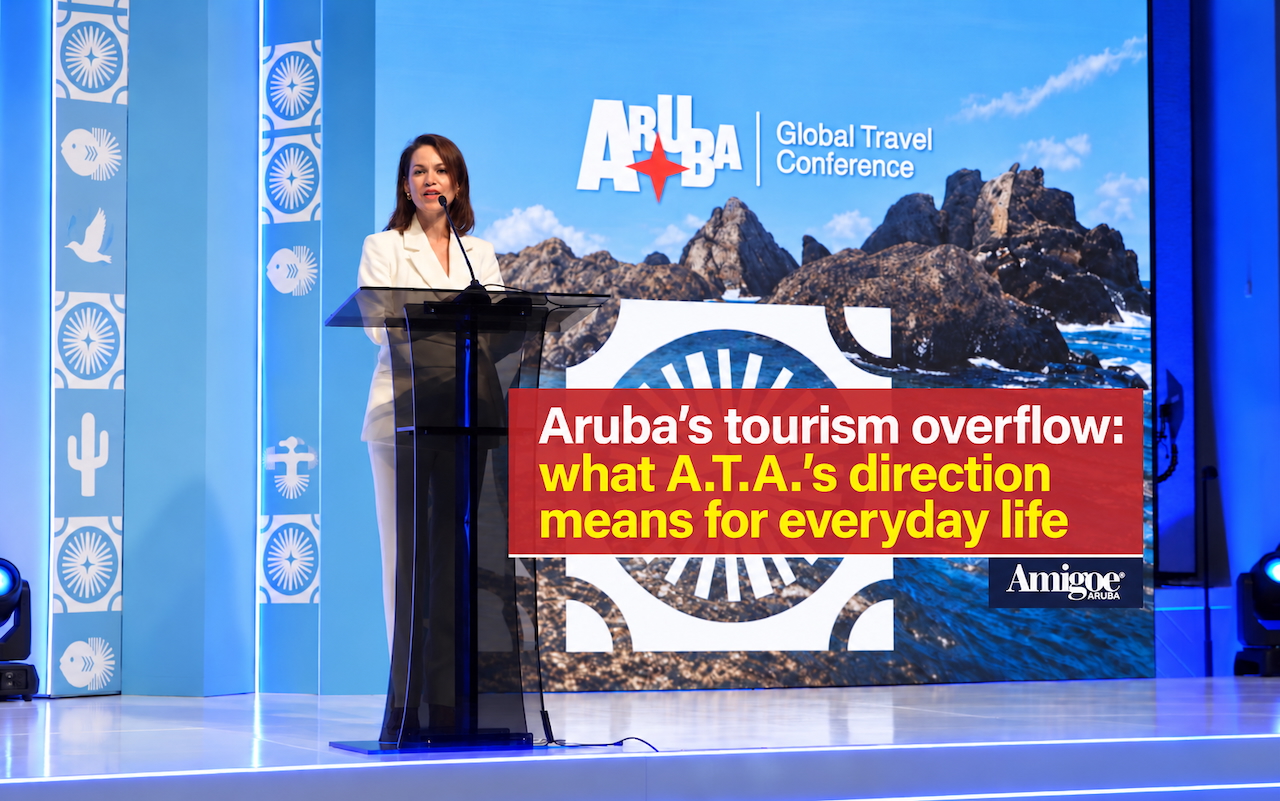
During the Aruba Global Travel Conference on September 15, which is directed toward Aruba’s international trade partners around the globe, A.T.A. CEO Ronella Croes made clear that the goal continues to be to move away from simply attracting more and more visitors. The focus is on attracting the right visitors, creating more value from tourism and protecting the island at the same time.
Croes summarized the challenge clearly:
“Aruba’s challenge today is not a lack of demand. It is how we preserve our beauty, authenticity, and quality of life.”
That sentence explains much of what has been, and continues to be, part of the change.
Tourism helped transform Aruba
To understand the current situation, it helps to look back.
After the oil refinery closed in 1985, unemployment increased sharply. Aruba then made tourism one of the main pillars of its economic future.
That decision worked.
Over the following decades, tourism became the engine of the Aruban economy. Hotels expanded, airlines added connections, international marketing increased, and Aruba became known worldwide as an in-demand and strongly performing Caribbean destination.
According to figures cited by Croes, tourism represented about 76.5 percent of Aruba’s GDP in 2025, with an even higher percentage projected for 2026.
That shows why tourism is so important.
But it also explains why Aruba has to manage it carefully — a message A.T.A. has, in fact, been emphasizing for years. It is important to remember that crystallizing the tourism model of “High Value, Low Impact” is by no means solely the responsibility of A.T.A.
Success brings pressure
More visitors create jobs, business activity and government revenue.
But more visitors also use roads, water, electricity, beaches, restaurants, rental cars and other parts of the island’s infrastructure.
Tourism is also no longer concentrated only in hotels.
Thousands of visitors now stay in short-term vacation rentals located throughout residential areas. That means tourism is increasingly part of neighborhoods as well. This brings prosperity and well-being to many, while also requiring more regulation.
This is where the idea of tourism overflow becomes important.
Aruba has succeeded in creating enormous demand. The next challenge is making sure that this success does not create more pressure than the island can comfortably handle.
That does not mean tourism has failed.
It means Aruba has reached a stage where managing success is becoming just as important as creating it.
A.T.A. wants slower growth
One of the clearest signals in Croes’ speech was that A.T.A. does not want unlimited growth in visitor numbers. This is not new; A.T.A. has been consistent on this front.
For 2027, A.T.A. projects growth in stayover tourism of only around 1.4 percent.
In simple terms, that means Aruba is not trying to increase visitor numbers as quickly as possible.
Instead, A.T.A. wants to focus more on visitors who contribute more economically to the island, while also ensuring that they fit within the responsible tourism model.
That can mean travelers who stay longer, spend more locally, use higher-value services, choose experiences that create greater benefits for Aruba, and help protect our island in many ways.
A.T.A. also wants to attract more premium air service and higher-value travelers from markets such as the United States, Latin America and Europe.
Destination Management remains at the core of A.T.A.’s marketing activities, with significant attention placed on safeguarding Aruba’s safety, beaches and hospitality.
There are many other areas of focus, including investments and efforts in wellness, destination weddings, eco-conscious initiatives and MICE — Meetings, Incentives, Conferences and Events.
A.T.A. invests significant effort in advocating for the various tourism-related matters that require attention and, when possible and aligned with its role, also invests in actual solutions.
The idea is straightforward:
More visitors are not automatically better if Aruba can create greater economic value without constantly increasing the number of people on the island.
Cruise tourism is also part of the discussion
The same thinking applies to cruise tourism.
A.T.A. wants cruise visitors to spend more money while they are on the island. Croes also said that limits on cruise arrivals are part of the current policy agenda.
That is an important shift.
Instead of only asking how many guests can arrive, the question becomes how Aruba can receive guests in a way that provides economic benefits without unnecessarily increasing congestion and pressure — and, in doing so, helping Aruba protect the island.
Short-term vacation rentals need better regulation
A.T.A. is also calling for a better regulated and more transparent short-term vacation rental sector.
A.T.A. has been advocating for this for more than a decade, while recognizing and advocating for the importance of the sector to the many people who benefit from the extra “cachi cachi.” That additional income has to be maintained.
This matters to residents because vacation rentals directly affect neighborhoods.
They influence traffic, parking, housing availability and the number of visitors staying in areas that were originally mainly residential.
That does not mean vacation rentals have no place in Aruba’s tourism economy.
They simply need to be regulated.
A.T.A. is not only advertising Aruba
Many people may think A.T.A.’s main job is simply promoting Aruba abroad.
That remains an important part of its work, but Croes explained that A.T.A., as a Destination Marketing and Management Organization (DMMO), devotes attention to both destination promotion and destination management.
In simple language, this means A.T.A. is not only trying to bring people of the desired profile to Aruba, but is also heavily engaged in their experience while on the island.
The latter continues to be critical as A.T.A. continues to elevate the profile of the visitors Aruba wishes to attract, while also taking into account all of Aruba’s accommodation and other business-sector partners.
Aruba is not aiming to become exclusively a luxury destination.
It wants to remain true to its product offering and DNA, and continues to offer something to anyone looking for a beach vacation — and ideally a beach+ vacation.
At the same time, the strategy continues to increase the share of travelers who reach or surpass defined annual household-income levels and who fit the responsible-tourism profile.
A.T.A. also looks at what happens after guests arrive and how tourism affects the island.
That includes questions such as:
How does tourism affect residents’ quality of life?
How much value does tourism create for the local economy?
Are visitors having a good experience?
And are the nature and culture that make people want to visit and return being protected and preserved?
Those questions have become part of how tourism success is measured.
Visitors also have a role
Another noticeable change is that A.T.A. wants visitors themselves to take more responsibility.
The message is no longer only about what Aruba can offer guests.
Croes also asked what guests can do to help protect Aruba.
That thinking is reflected in A.T.A.’s message:
“When You Love Aruba, It Loves You Back.”
“Cuando Amas Aruba, Aruba te Ama.”
According to research cited by A.T.A., most travelers say responsible tourism is important to them, and many say they want to make a positive impact on the places they visit.
The problem is that relatively few visitors say they have actually been shown how to do that.
For Aruba, that creates an opportunity.
Visitors can be encouraged to respect nature, support local businesses, follow rules in protected areas and understand that they are visiting a small island with limited resources.
A.T.A. cannot solve everything alone
It is also important to understand that A.T.A. cannot control every issue connected to tourism.
Problems involving roads, housing, construction, waste, water, energy, permits and enforcement involve different parts of government.
Managing Aruba’s physical limits requires cooperation across government, businesses and the wider community.
That is why the next phase of tourism has to depend on planning and integrated tourism management that is cross-ministerial and based on public-private cooperation.
The next chapter
Aruba has already shown that it knows how to create tourism demand.
The next test is whether the island can manage that demand in a way that works for both visitors and residents.
Croes ended her speech with a simple message:
“Un Aruba dushi pa biba ta un Aruba dushi pa bishita.”
A wonderful Aruba to live in is a wonderful Aruba to visit.
That may be the easiest way to understand A.T.A.’s direction, which it has been advocating for and continues to pursue.
The goal is not to stop tourism.
The goal is to make sure that tourism remains strong without weakening the qualities that made Aruba successful in the first place.
Aruba’s next tourism challenge is not about attracting more attention from the world. It is about learning how to manage the enormous success it has already created — “Un reto di Luho.”