


© 2025 Aruba Intelligence - Quantum Quorum Media


Court allows enforcement against e-steps to continue: renting without a permit provisionally considered a violation
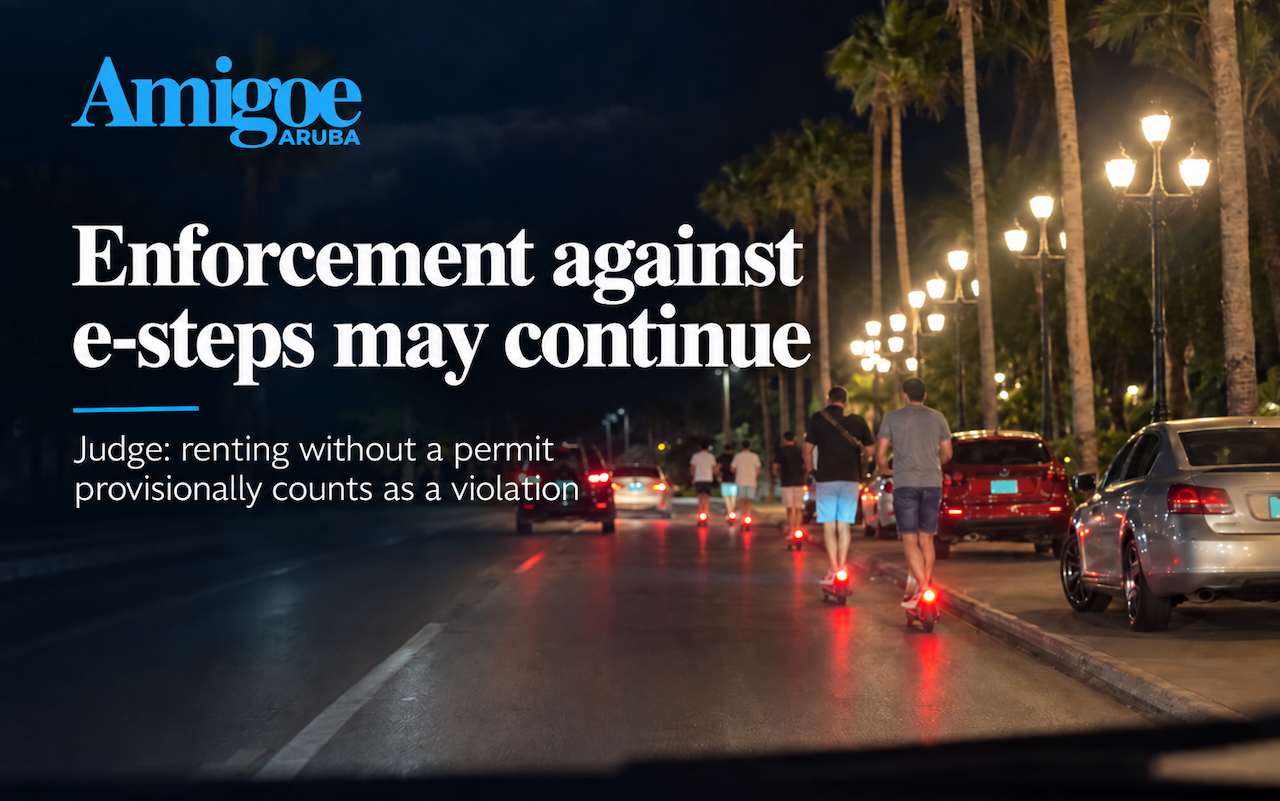
ORANJESTAD — The Court of First Instance of Aruba on Wednesday, September 16, rejected the requests of Friendly Green Bike Company Aruba VBA and Evikes Corporation VBA to suspend the penalty orders imposed on them. The court provisionally ruled that electric steps and e-bikes rented out without a driver fall under the Landsverordening personenvervoer and therefore require a permit. Because both companies do not have that permit, the court concluded that there is a violation.
The ruling marks an important new chapter in the legal dispute that has been ongoing since April between the government and companies renting out electric vehicles.
On June 29, the minister responsible for public transport separately imposed an order subject to penalty payments on both companies. They were required, within fifteen calendar days, to stop commercially offering and renting out electric steps, bicycles and scooters for use on or from public roads as long as they do not hold the required permit. They were also ordered to disable digital rental options and to stop making the vehicles available on or along public roads.
According to the decisions, a penalty of Afl. 500 per individual vehicle offered per calendar day or part thereof can be imposed in case of non-compliance.
Court: e-step falls under definition of rental motorcycle
The most important legal part of the ruling can be found in consideration 9.2.
Green Bike and Evikes argued that the Landsverordening personenvervoer does not apply to e-bikes and e-steps and that they therefore do not require a permit.
The court provisionally rejected that argument.
According to the court, e-steps and e-bikes are two-wheeled vehicles without an enclosed body that are powered wholly or partly by mechanical force, in this case an electric motor. Because these vehicles are rented to third parties without a driver, the court found that they fall within the legal definition of a rental motorcycle.
As a result, the court held that a permit under Article 3, paragraph 3, of the Landsverordening personenvervoer is required. Because Green Bike and Evikes currently do not have such a permit, the court concluded that a violation exists.
Different from the May ruling
The new decision must be distinguished from the ruling of May 22.
At that time, the court prohibited the government from seizing electric steps and bicycles belonging to both companies without a legally valid administrative decision as a basis. The court ruled that the government had to follow the prescribed legal procedure when enforcing the rules.
That May ruling did not mean that the court had determined that renting out e-steps without a permit was legal.
After the May judgment, the government formally warned both companies in writing, followed by the penalty orders issued on June 29. The dispute decided on September 16 concerned whether those measures should be suspended pending the outcome of the companies’ objections.
Financial harm not enough to suspend enforcement
Green Bike and Evikes argued that immediate enforcement would have serious financial consequences and could put the continuity of their businesses at risk.
The court acknowledged that their financial position is under pressure and even found that there was sufficient urgency to assess their request on its merits.
That did not, however, result in a ruling in favor of the companies.
The court ultimately concluded that their financial interests do not outweigh the general interest in enforcing the permit requirement and, as argued by the government, road safety.
The court also found that there is currently no concrete prospect of legalization. Although the companies have submitted permit applications, the court stated that it has not been made sufficiently plausible that those permits must be granted.
Minister welcomes the ruling
Justice Minister Arthur Dowers responded positively to the ruling and indicated that the government intends to continue with further enforcement measures.
His political response, however, must be legally distinguished from what the court actually decided.
The court has not fully concluded the underlying objection proceedings. The September 16 ruling concerns the companies’ requests for provisional relief to suspend enforcement. Their objections against the June 29 decisions still have to be dealt with through the administrative-law procedure.
However, according to the ruling, no appeal can be filed against this specific decision on the request for provisional relief.
Legal position now significantly clearer
The legal position is therefore considerably clearer than it was several months ago.
For the time being, the penalty orders remain in force. In this provisional-relief procedure, the court accepted the legal basis for the permit requirement and found that both companies are acting in violation of that requirement by operating without the necessary permit.
A separate public response from Green Bike or Evikes to the September 16 ruling was not available in the sources reviewed by Amigoe Aruba at the time of publication. Their legal position is, however, set out extensively in the judgment: they dispute that the Landsverordening personenvervoer applies to their vehicles and point, among other things, to the financial consequences and their pending permit applications.
The administrative proceedings are therefore not completely over, but for immediate enforcement the court has now issued a clear decision:
the penalty orders will not be suspended.