


© 2025 Aruba Intelligence - Quantum Quorum Media


Survey: locals and visitors favor stronger protection of Aruba’s nature and clear rules for UTVs and ATVs
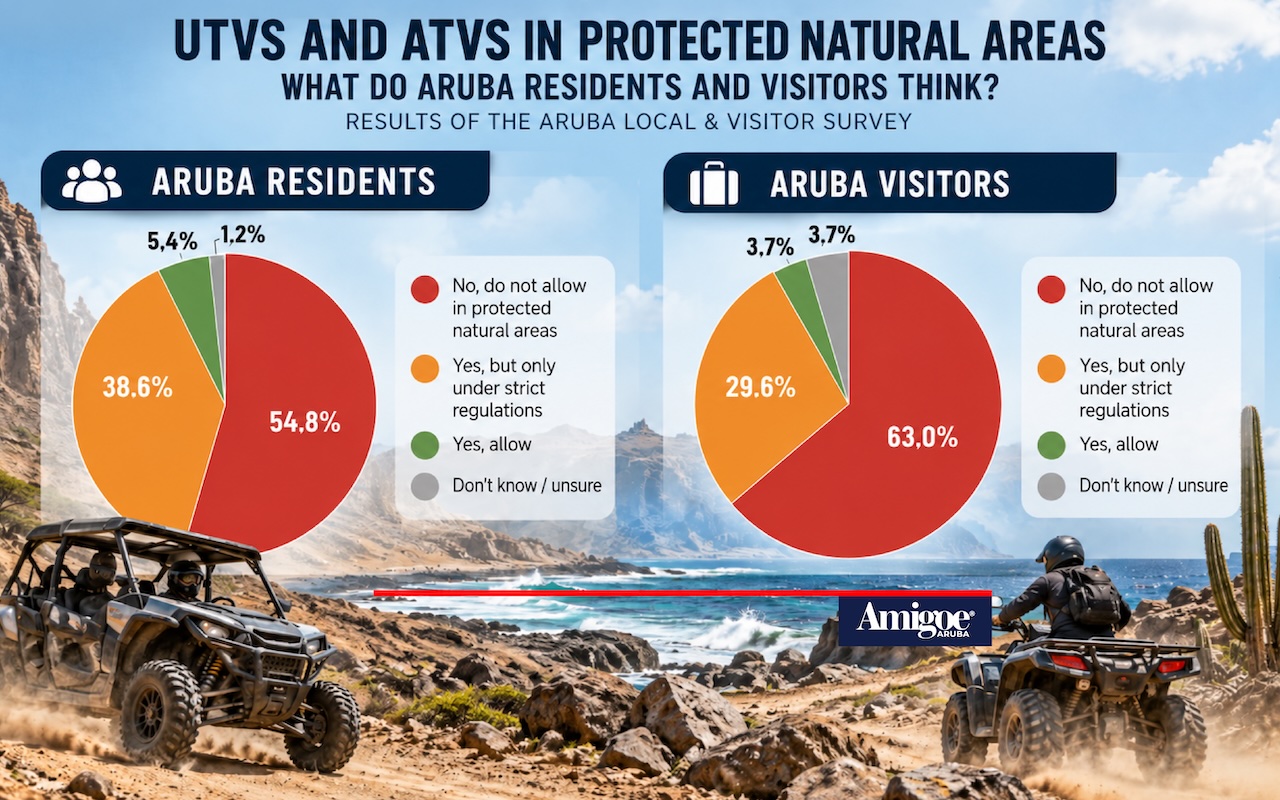
ORANJESTAD — Results from the Aruba Local & Visitor Survey show a striking similarity between residents and visitors. In both groups, there is very little support for unrestricted UTV and ATV use in protected natural areas. Among local respondents, 54.8% say these vehicles should not be allowed in protected natural areas, while 38.6% would accept their use only under strict regulations. Among visitors, 63.0% oppose UTV and ATV use in protected natural areas, while 29.6% would allow it only under strict conditions.
The survey was designed to place two perspectives side by side: how Aruba residents view the debate over tourism and nature, and what visitors themselves expect from the island.
The findings do not show a simple conflict between tourism and environmental protection. Both residents and visitors demonstrate strong support for protecting nature, while a significant segment of both groups still sees room for tourism activities if they are clearly regulated.
More than 93% of locals choose prohibition or strict regulation
Among local respondents, 54.8% say UTV and ATV use should not be permitted in protected natural areas.
Another 38.6% believe such use should only be possible under strict regulations.
Only 5.4% support allowing the activity without that additional condition, while 1.2% are unsure.
Combined, 93.4% of local respondents favor either no UTV/ATV use in protected natural areas or use only under strict conditions.
The pattern among visitors is remarkably similar.
Among visitors, 63.0% say UTVs and ATVs should not be allowed in protected natural areas, while 29.6% would accept their use only under strict regulation.
Together, that represents 92.6% of visitors.
Nature protection ranks extremely high among both groups
Residents and visitors are also closely aligned when asked how important the protection of Aruba’s natural environment is.
Among locals, 81.3% consider nature protection “extremely important,” while another 13.9% consider it “very important.”
Combined, that is 95.2%.
Among visitors, 87.0% describe nature protection as extremely important and 9.3% as very important.
Together, that amounts to 96.3%.
The results indicate that protecting Aruba’s natural environment carries very substantial weight for both groups.
Locals favor designated routes, speed limits and licensed guides
The local survey also asked which measures should apply if UTVs and ATVs are allowed under certain conditions.
72.9% support designated routes only.
62.7% support speed limits, while 61.4% favor the use of licensed guides.
There is also broad support for restricted operating hours, noise regulations, environmental contributions and substantial fines for violations.
45.2% support temporarily closing sensitive areas when ecological conditions require it.
Within the same multiple-choice question, 41.0% also selected the option that UTVs and ATVs should not be allowed at all.
The results therefore do not indicate broad support for unrestricted access. Even among respondents who see a place for UTV and ATV activities, there is substantial support for a much more tightly controlled system.
Visitors favor many of the same measures
Visitors identify many of the same solutions.
59.3% support certified tour guides and the same percentage supports speed limits.
55.6% favor designated routes only.
53.7% support temporary closures of environmentally sensitive areas, while 51.9% favor limits on the number of vehicles per group.
Exactly 50.0% support GPS or geofencing technology to prevent vehicles from leaving authorized routes.
Another 50.0% support substantial fines for violations.
Several of these measures closely resemble proposals that have recently been presented to the government by Tour Operator Uni, including route demarcation, GPS monitoring, speed limits, certified guides and sanctions for violations.
Nearly half of visitors favor a complete ban inside protected natural areas
When visitors were asked which model they specifically prefer for protected natural areas, 48.1% chose a complete ban on UTVs and ATVs within those areas.
Another 18.5% favor alternative routes outside ecologically sensitive zones.
14.8% prefer officially designated routes, while 11.1% support guided tours only with licensed guides.
Just 1.9% favor continuing the previous system without fundamental changes.
The results suggest that visitors largely favor one of two approaches: full protection of sensitive natural areas, or access only under clearly defined and controlled conditions.
Stronger nature protection makes Aruba more attractive to visitors
An important part of the survey examined whether stronger environmental protection could discourage tourists.
The results point in the opposite direction.
68.5% of visitors say stronger nature protection would make their perception of Aruba “much more positive.”
Another 16.7% say it would make their view of Aruba more positive.
Combined, 85.2% say stronger protection would improve their perception of the destination.
Another 13.0% say it would make no difference.
Only a very small percentage expect a clearly negative impact.
The same pattern appears when visitors are asked whether stronger environmental protection would affect their likelihood of visiting Aruba in the future.
44.4% say it would make them more likely to visit.
Another 44.4% say it would have no effect.
That means the effect is positive or neutral for almost 89% of visitors surveyed.
Two-thirds of visitors say nature should come first
When asked to make a direct choice between nature protection and tourism activity, 66.7% of visitors say protecting nature should take priority, even if that means certain tourism activities have to stop.
The remaining 33.3% prefer a balance in which tourism and nature can coexist through regulation.
No respondent in this question chose a model in which tourism activity should take priority without additional environmental safeguards.
Locals critical of current approach
The local results also send a clear signal regarding the current situation.
57.8% rate it as “very poor” and 26.5% as “poor.”
Combined, 84.3% give a negative assessment.
When asked who carries primary responsibility, 52.4% point to the government.
Another 39.8% believe all parties involved should share responsibility.
This suggests that for residents, the debate is not only about introducing new rules. Implementation, supervision and enforcement are also central concerns.
Residents and visitors are closer than the debate may suggest
Perhaps the most important finding is not the difference between locals and tourists, but how closely their views align.
Among local respondents, 93.4% favor either no UTV/ATV use in protected natural areas or use only under strict regulations.
Among visitors, that figure is 92.6%.
More than 95% of both groups also consider protecting Aruba’s natural environment very or extremely important.
The findings therefore offer little support for the idea that Aruba must necessarily choose between environmental protection and an attractive tourism product.
Instead, the survey points toward a third approach:
protect sensitive natural areas, clearly define where access is allowed, make routes physically and digitally enforceable, and consistently sanction violations.
The results should be understood as the findings of an online survey among voluntary participants and not as a scientifically representative poll of Aruba’s entire population or all visitors to the island.
Still, one conclusion stands out clearly:
the status quo receives very little support.