

© 2025 Aruba Intelligence - Quantum Quorum Media


A.T.A. broadens new tourism strategy: local community, culture and infrastructure take center stage
ORANJESTAD — The Aruba Tourism Authority (A.T.A.) wants to connect the future development of tourism more explicitly with the quality of life in Aruba itself. During a presentation to the press, A.T.A. made clear that its new direction goes beyond encouraging responsible behavior among visitors. Communication with residents, investments in public and tourism infrastructure, cultural development and the responsibilities of the local community are also becoming part of the broader tourism strategy.
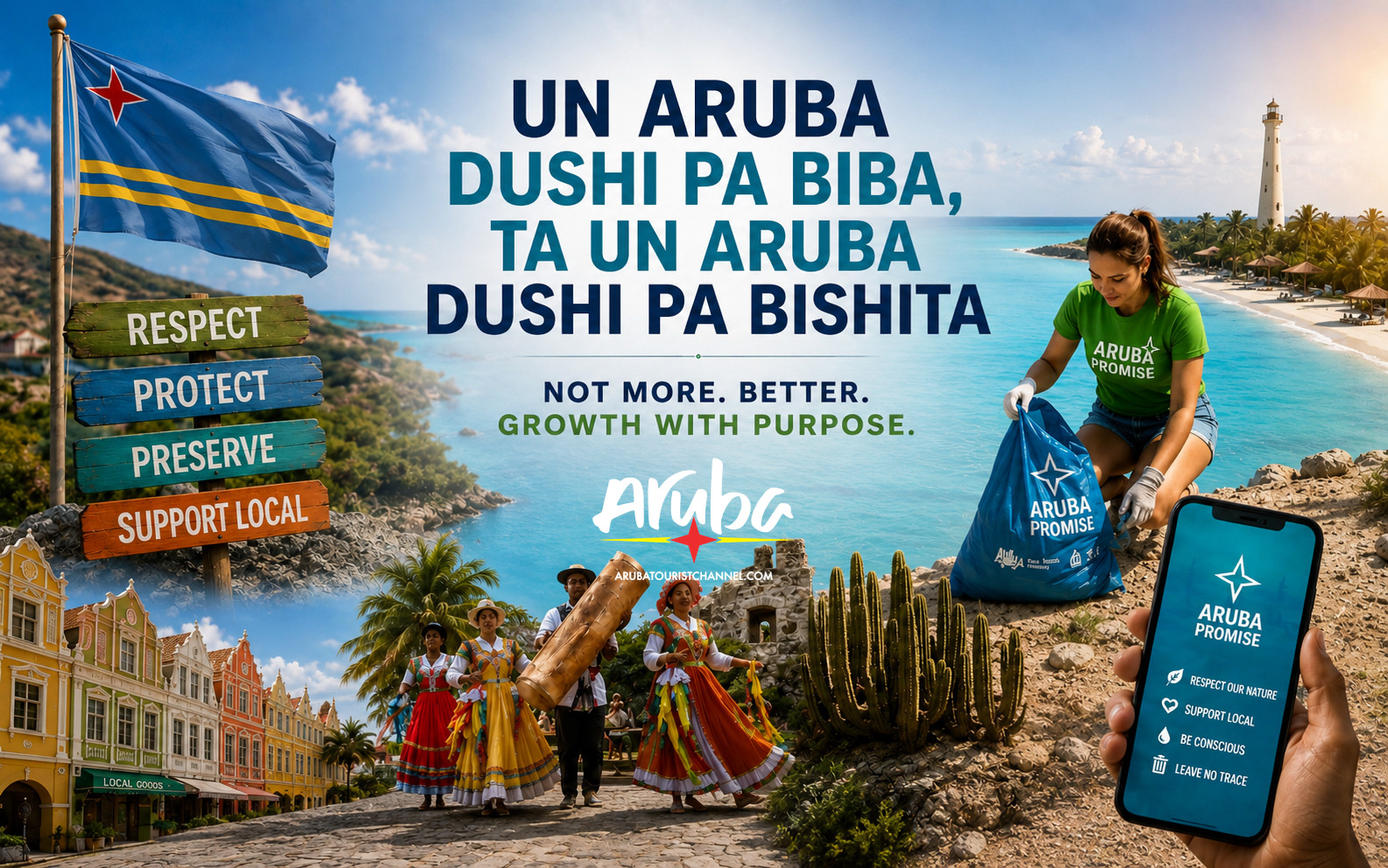
The central message remains: “Un Aruba dushi pa biba, ta un Aruba dushi pa bishita” — an Aruba that is a good place to live is also an Aruba that remains a good place to visit.
This represents a shift away from a traditional model focused primarily on visitor growth and destination promotion toward one in which value and impact are given greater importance.
A.T.A. presented this development as an evolution from “Tourism 1.0” toward “Tourism 4.0.” After tourism initially functioned as a supplementary economic activity and subsequently developed into one of Aruba’s core industries, greater emphasis was placed from 2018 onward on a “high-value, low-impact” model.
For the 2025–2035 period, A.T.A. speaks of a transition toward a “regenerative guest economy”: a tourism economy that does not merely generate economic returns, but should also contribute positively to the destination on which it depends.
The underlying message was summarized during the presentation as: “Not more. Better. Growth with purpose.”
Responsibility does not apply only to visitors
An important element of the presentation was A.T.A.’s position that responsibility cannot be placed exclusively on visitors.
One of the slides explicitly stated: “Loke nos ta pidi di nos huespednan, nos ta pidi di nos mes tambe” — what we ask of our guests, we must also ask of ourselves.
Three principles were highlighted: the same commitment from local residents, the local community setting the example, and shared responsibility.
This places responsible tourism within a broader context. If visitors are asked to keep natural areas clean, use public facilities responsibly and respect Aruban culture, the same responsibility applies to residents and local organizations under this approach.
Press positioned as a partner in responsible tourism
A.T.A. also directly connected this new direction with the role of the press.
During the presentation, the press was described as a “partner in responsible tourism.” Media were encouraged to share accurate information with the necessary context, translate important tourism issues into information that is accessible and understandable to the community, and amplify positive examples of responsible behavior.
This does not alter the independent watchdog role of journalism. It does, however, demonstrate that A.T.A. increasingly sees local media as an important channel through which the broader public discussion surrounding tourism can take place.
The approach forms part of A.T.A.’s Business-to-Local (B2L) model, which places four communication functions at its core: informing, providing context, inspiring and connecting.
Rather than communicating only how many visitors Aruba receives, A.T.A. wants to explain what developments within the tourism industry mean for the population.
From ‘tourist’ to ‘guest’
The terminology is also changing.
Where communication traditionally referred to “tourists” and growth, A.T.A. increasingly uses concepts such as “guest” or “visitor,” “value and impact,” “research and context,” and “preservation and protection.”
The change in vocabulary reflects a broader change in philosophy. A visitor is no longer regarded solely as a consumer of accommodation, beaches and activities, but as a temporary guest of a society and its natural environment.
This message is closely connected to the Aruba Promise, through which visitors are encouraged to treat the island respectfully.
During the presentation, A.T.A. emphasized that the Aruba Promise should ultimately translate into practical behavior: protecting nature, using water and energy consciously, respecting local culture and customs, and supporting the local economy.
From ‘Feel it’ to ‘Protect it’
Aruba’s international positioning is also being adjusted.
A.T.A. presented a four-stage journey:
Feel it → Want it → Get it → Protect it.
The first stages are intended to create an emotional connection with Aruba, attract visitors who fit the destination’s desired positioning and highlight local experiences. The fourth stage — “Protect it” — encourages visitors to recognize and respect the vulnerability of the island.
Protection therefore no longer stands apart from tourism marketing; it becomes part of the marketing strategy itself.
Communication continues throughout the visitor’s stay
Through its Business-to-Guest (B2G) strategy, A.T.A. also intends to continue communicating with visitors throughout their entire journey.
Traditional tourism marketing is largely focused on the period before travel: convincing a potential visitor to choose Aruba. Under the new model, communication continues after the visitor has arrived on the island.
A.T.A. identifies three principal functions: education, practical guidance and influencing responsible behavior.
Communication can take place during different stages of the journey, including arrival, transportation, accommodation, experiences, consumption and departure.
Various channels can be used, including communications at the airport and within tourism zones, digital platforms, hotels, taxis, Aruba.com and other media.
New information platform for the community and press
During the presentation, A.T.A. also highlighted Ata.aw, which is intended to function as an official information source for the community and the press.
According to the presentation, information will be organized into three main sections: State of the Industry, providing current data and information on Aruba’s tourism industry; a Knowledge Base, containing monthly and annual reports available for consultation and download; and Press & News, bringing A.T.A. press releases together in one location.
The emphasis on a centralized information platform is consistent with the B2L principle: tourism results should not merely be published, but also placed within a meaningful local context.
Cultural development becomes part of the tourism strategy
The presentation also demonstrated that A.T.A. defines its role more broadly than international destination promotion.
Under the heading “Cultural Development,” A.T.A. explained that it intends to contribute to preserving and promoting Aruba’s cultural identity through festivals, artistic initiatives and community projects.
Examples presented included the Aruba Art Fair and Youth Art Fair, Carubbian and other community festivals, activities by Fundacion Chico Harms surrounding Dia di Brazil, and collaborations with local content creators.
The underlying principle is that culture should not simply be treated as a tourism product. Local cultural development should first have value for the community itself and can subsequently contribute to a more authentic visitor experience.
This approach directly raises the question of which aspects of Aruba should be developed for visitors and which should be protected because they form part of the island’s own identity.
Investments spread across the island
Another significant component of the presentation concerned a map of planned development and refurbishment projects beginning in 2025.
The projects are distributed across different parts of Aruba. They include research and construction of equestrian trails, a mountain-bike trail in the Salina Druif area, traffic-flow and parking improvements at the California Lighthouse, Casibari and Tres Trapi, visitor-access management at Bushiribana, and development at Bushiri Beach.
Projects at Baby Beach, Eagle Beach and Rodgers Beach were also listed, including public restrooms, parking improvements, sports facilities, visitor amenities and maintenance.
Further refurbishment projects mentioned include stairs at Parke Arawak Conchi, infrastructure at Mangel Halto, palapas and gazebos at Eagle Beach, the boat ramp at Rodgers Beach and facilities at Casibari and Ayo.
The map therefore demonstrates that the new tourism strategy is not being implemented solely through marketing and communication. Physical infrastructure, visitor flows, public facilities and maintenance of tourism locations also form part of the approach.
Tourism increasingly becomes destination management
Taken together, the different elements presented point toward a broader institutional shift.
A.T.A. is moving further from exclusively destination marketing toward destination management.
Under a traditional destination-marketing model, the central question is primarily how Aruba can be promoted internationally and how visitors can be attracted. Destination management raises broader questions: Which visitors are appropriate for Aruba? What economic value do they generate? What is their impact on the community and the natural environment? How should visitor flows be managed? And what investments are necessary to keep the destination sustainable and livable in the long term?
The Aruban population consequently assumes a different position within the tourism model. Residents are not merely employees or entrepreneurs within the tourism economy; their quality of life increasingly becomes part of the assessment of whether that economy is functioning successfully.
That gives the slogan “Un Aruba dushi pa biba, ta un Aruba dushi pa bishita” a meaning that extends beyond communication.
The new direction effectively argues that the two objectives are interdependent: Aruba can remain a high-quality tourism destination in the long term only if the island simultaneously remains a high-quality place for its own residents to live.
The measure of tourism success is therefore gradually becoming broader. The question is no longer only how many people visit Aruba, but what their visit ultimately leaves behind for Aruba.