

© 2025 Aruba Intelligence - Quantum Quorum Media


Aruba presents its path toward regenerative tourism by 2030 in Argentina
BUENOS AIRES/ORANJESTAD – Aruba aims to take the next step from responsible and sustainable tourism toward a regenerative tourism model by 2030. Under this approach, the tourism sector should not only generate economic benefits and reduce negative impacts, but also make a measurable contribution to restoring nature, strengthening local communities and preserving Aruba’s identity.
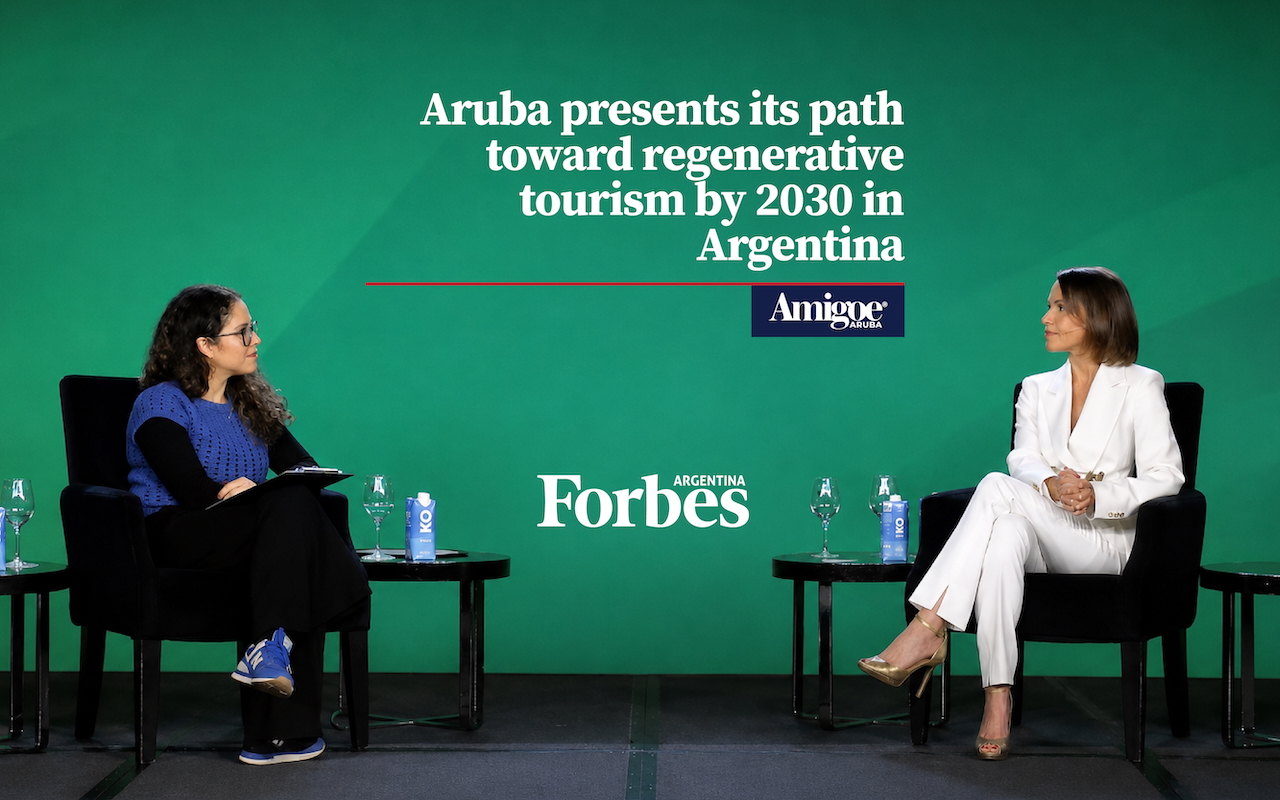
Ronella Croes, Chief Executive Officer of the Aruba Tourism Authority, presented this direction during the Forbes Sustainability Summit in Argentina. In a conversation with Forbes editor Florencia Radici, she explained how Aruba intends to continue developing its tourism economy without losing sight of the island’s liveability and the interests of its residents.
According to Croes, Aruba made a deliberate decision in 1986 to develop an economy in which tourism would take a leading role. She said this transformation was made possible through investments in infrastructure, international connectivity, marketing and institutional development.
In 2011, the Aruba Tourism Authority obtained an autonomous public-law status, enabling the organisation to manage both destination marketing and comprehensive destination management.
The Government of Aruba now describes ATA as a Destination Marketing and Management Organisation. Its role is not limited to attracting visitors, but also includes guiding the sustainable development of Aruba as a destination.
According to the government, tourism revenues have increased by 94 percent and visitor numbers by 43 percent since ATA became autonomous in 2011.
Growth is no longer the only criterion
According to the figures presented during the conference, tourism now represents more than 70 percent of Aruba’s gross domestic product.
The central policy question is therefore no longer only how many visitors Aruba can attract, but also what economic, social and environmental value tourism creates for the island.
ATA is consequently working according to the principle of High Value – Low Impact. This model focuses on generating greater value per visitor while limiting pressure on nature, infrastructure and local communities.
ATA’s Corporate Plan 2026 also refers to a transition from a traditional tourism industry toward a “regenerative visitor economy.” According to the plan, tourism should ultimately do more than reduce its negative footprint; it should actively help restore and strengthen Aruba.
The difference between sustainable and regenerative tourism is significant. Sustainable tourism mainly focuses on preventing and reducing harm. Regenerative tourism goes further by seeking to leave natural areas, neighbourhoods, culture and community structures in a better condition than before the tourism activity took place.
Residents placed at the centre of tourism policy
Croes emphasised in Argentina that the views of Aruba’s residents must have a structural role in tourism policy.
According to her, ATA has been researching the concerns, expectations and perceptions of the local population since before the COVID-19 pandemic.
The organisation says it uses these findings when deciding on investments and during discussions with the government and the private sector.
The underlying principle is that a destination can only remain attractive in the long term when it first remains a good and liveable place for the people who reside there.
This approach is summarised in the policy statement: “An Aruba that is good to live in is an Aruba that is good to visit.”
The same philosophy forms an important part of the campaign When You Love Aruba, Aruba Loves You Back, in which visitors are approached not merely as consumers, but as guests who share responsibility for the island.
Travellers expect greater responsibility
ATA partly bases its new direction on its international Responsible Tourism Impact Report. More than 7,000 travellers in seven countries were surveyed for the study.
The results show that 96 percent consider responsible tourism important, while 80 percent believe tourism should improve the lives of local residents.
A further 80 percent believe that local communities should have a say in how tourism is developed.
At the same time, the study reveals a clear gap between willingness and practical action. Although 73 percent of respondents want to learn how they can make a positive contribution while travelling, only 23 percent believe the tourism sector provides sufficient guidance.
In other words, 77 percent feel they do not receive enough concrete information about how to travel responsibly.
Aruba is attempting to address this gap through the Aruba Promise. Visitors are asked to consider their environmental footprint, respect nature and biodiversity, support local communities and behave as responsible guests.
Nature conservation as part of tourism policy
The cooperation between ATA and the Aruba Conservation Foundation forms part of this approach.
The foundation manages several protected terrestrial, coastal and marine areas, including the 34-square-kilometre Parke Nacional Arikok, as well as several wetlands and marine conservation zones.
According to ATA’s policy documents, tourism should contribute to nature conservation, cultural preservation, education and social development.
The Corporate Plan 2026 includes separate environmental, social and economic commitments. These include restoring nature, strengthening cultural heritage and creating additional economic value for Aruba through the visitor economy.
Technology to prevent overcrowding
Alongside policy and awareness campaigns, ATA intends to use technology to manage visitor flows more effectively.
Croes stated during the interview that sensors have been installed at busy locations to measure the number of people present and monitor the movement of visitors.
According to her, this data makes it possible to determine when certain locations are under pressure. Visitors can then be directed to alternative times or different locations.
The technology is intended to help prevent Aruba from experiencing the negative consequences of overtourism, such as excessive pressure on natural areas, infrastructure and residential communities.
The precise locations, measurement methods and results of these sensors were not disclosed during the presentation.
Argentina becomes Aruba’s leading Latin American market
The decision to present Aruba’s vision in Argentina is also related to the country’s growing importance to Aruba’s tourism sector.
According to Croes, Aruba received approximately 59,000 visitors from Argentina through May 2026. This would represent an increase of 194 percent compared with the same period a year earlier.
According to ATA, Argentina has consequently become Aruba’s largest Latin American source market, surpassing Colombia.
Croes said that diversifying source markets is necessary to reduce Aruba’s dependence on a limited number of countries.
The policy direction presented in Argentina therefore marks a broader change in how Aruba intends to define tourism success.
Visitor numbers alone will no longer be decisive. Revenue per visitor, nature conservation, cultural continuity, support among residents and the distribution of economic benefits are also expected to become important indicators.
Whether Aruba will be able to complete the transition from sustainable to regenerative tourism by 2030 will ultimately depend on concrete implementation, publicly measurable objectives and cooperation between the government, ATA, nature conservation organisations, businesses, residents and visitors.
The policy documents establish the direction. The coming years will determine to what extent these ambitions translate into measurable benefits for the island and its population.