

© 2025 Aruba Intelligence - Quantum Quorum Media


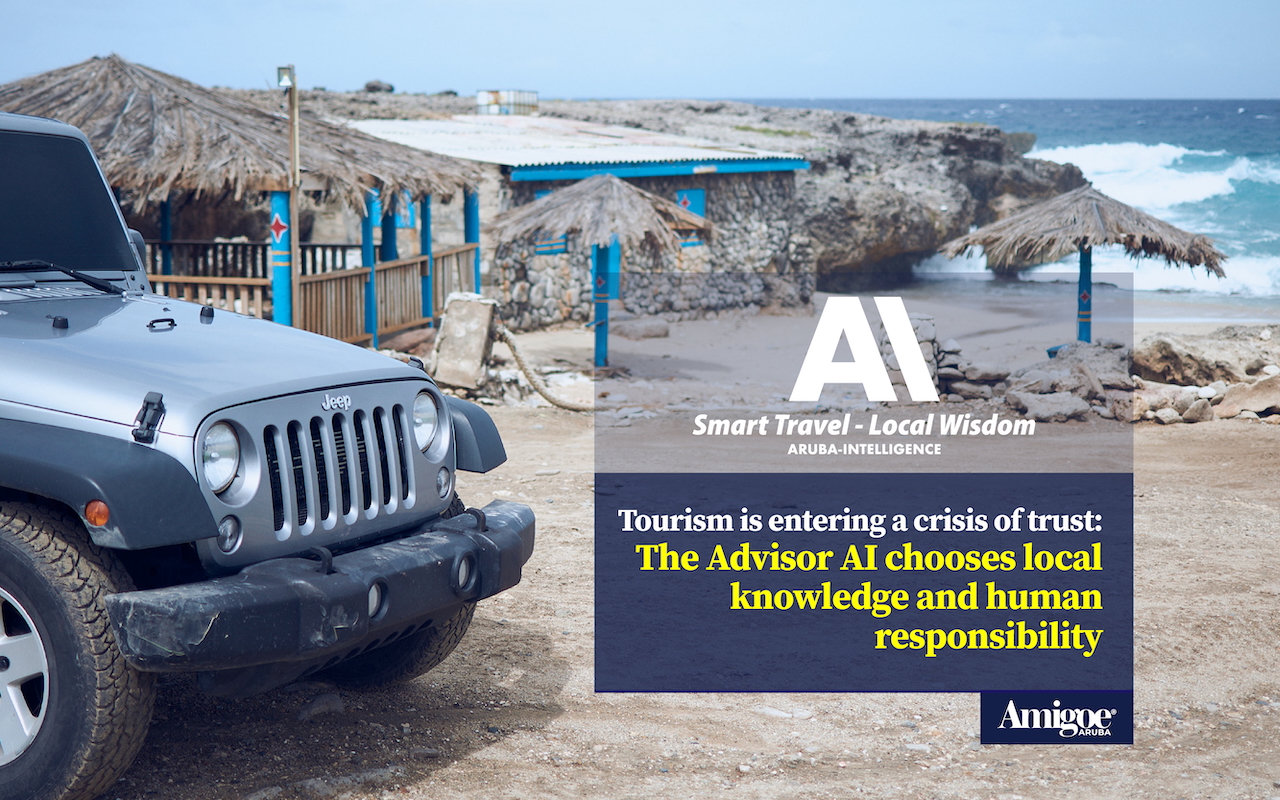
Tourism is entering a crisis of trust: The Advisor AI chooses local knowledge and human responsibility
The future of travel advice will not be determined by who can generate the most recommendations, but by who accepts responsibility for their quality
Analysis | By Ishwar Daryanani
Twenty years ago, visitors asked local residents where they should eat, which beach they should visit and which experiences genuinely represented Aruba. Then came guidebooks, TripAdvisor, social media and influencers. Today, travellers increasingly ask artificial intelligence those same questions.
The way people discover destinations has changed completely. Yet this abundance of information has not eliminated uncertainty. Travellers now have access to more reviews, rankings, videos, recommendations and automatically generated itineraries than ever before, but that does not necessarily mean they know which choice is genuinely right for them.
I therefore believe that tourism is entering not only a recommendation crisis, but above all a crisis of trust.
The central question is no longer simply:
Who is making the recommendation?
The real question is becoming:
Whom do I trust enough to base my decision on that recommendation?
Travellers want to use AI, but do not yet fully trust it
Research conducted by Booking.com among more than 37,000 consumers in 33 markets clearly demonstrates this contradiction. According to the study, 89 percent of respondents want to use AI in future travel planning. At the same time, only 6 percent say they fully trust AI, while 91 percent have at least one concern about how the technology works or what its consequences may be.
That distinction is essential. It demonstrates that convenience and trust are not the same thing.
A traveller may use AI because it is fast, but still verify whether a restaurant actually exists, whether a hotel truly meets expectations or whether a recommended location is suitable for children, older visitors or people with limited mobility.
The problem is therefore not a lack of available information. The problem is that information without context does not provide certainty.
The discussion shows that trust has several layers
The discussion beneath Delia Moisa’s LinkedIn post adds an important perspective. The responses demonstrate that trust in tourism is not created at a single moment and cannot be guaranteed by one technology alone.
One contributor argued that the problem is not AI-generated recommendations themselves, but recommendations produced without sufficient understanding. When a system mainly promotes what is popular, sponsored, highly visible or easy to rank, it does not create trust. A recommendation becomes valuable only when it is based on local knowledge, clear context and the traveller’s actual intent.
That distinction is fundamental to The Advisor AI.
Popularity is not the same as relevance. Paid visibility is not the same as reliability. A generic connection between a search term and a business is not yet a personal recommendation.
AI can only recommend what it understands
Another point raised in the discussion is that trust begins before a recommendation is generated. Hotels, restaurants, activities and destinations must be described in a reliable, clear and AI-readable way.
An AI system can only reason with the information it receives. When opening hours are outdated, services are described vaguely or commercial claims are presented as objective facts, even a technically advanced system cannot provide a dependable outcome.
This means that smart tourism does not begin with a chatbot. It begins with a properly managed knowledge infrastructure.
That is why The Advisor AI was not developed merely as a conversational interface. Behind the system is an Aruba-focused knowledge base containing information about beaches, gastronomy, culture, history, family activities, nature, wellness, events and practical travel matters.
The quality of a digital concierge is ultimately not determined by how human its answers sound, but by the reliability of the knowledge on which those answers are based.
Outdated information is a direct risk
One of the most critical comments described how an AI system recommended two permanently closed locations while planning a trip and failed to identify several places that closely matched the traveller’s interests.
This is not a theoretical risk.
A general AI system may rely on information published months or even years ago. Restaurants close, opening hours change, excursions disappear, roads are modified and government regulations may be amended. An answer can sound convincing while still being factually outdated.
For The Advisor AI, this means that current information must be a structural part of the system. The knowledge base must be continuously reviewed, corrected and expanded. Local businesses should be able to update their information, but that information must also be verified against official or independent sources where necessary.
A genuine digital concierge must do more than generate answers. It must also recognise when information is uncertain and when further verification is required.
Trust is created when someone accepts responsibility
Another contributor introduced the concept of responsibility. Now that AI can generate an almost unlimited number of recommendations, the recommendation itself is becoming less distinctive. The real value lies with the person or organisation willing to attach its name to a choice and accept responsibility when that choice proves to be wrong.
This reveals an important limitation of complete automation.
An algorithm can recommend a restaurant, but it will not answer the telephone when the reservation does not exist. It can suggest a transport option, but it cannot resolve the situation when a visitor is left waiting at the wrong location. It can recommend an activity, but it does not accept responsibility when the actual experience differs significantly from what was promised.
The Advisor AI should therefore not become an anonymous recommendation mechanism. It must remain connected to a recognisable Aruban organisation, a managed knowledge base and human support.
Trust requires an accountable point of contact.
The human travel professional is not disappearing
Another view expressed in the discussion is that trust in travel professionals has not necessarily disappeared, but has moved to a later stage in the customer journey.
Many modern travellers want to discover and organise their holidays independently. The value of human expertise becomes particularly visible when expectations and reality no longer correspond after arrival, or when practical problems arise.
This is an important principle in the development of The Advisor AI.
The system is not intended to replace every human interaction. It should support visitors during different phases of the journey: before departure, upon arrival, throughout their stay and whenever a situation requires human intervention.
Smart tourism does not mean removing people from the process. It means using technology to determine when automation is efficient and when human knowledge, hospitality or problem-solving is necessary.
Consistency between promise and experience
Several contributors emphasised that trust is not built through more data, but through consistency between what is promised in advance and what the traveller eventually experiences.
A destination can present itself as authentic, welcoming and sustainable. When the actual experience does not reflect those promises, the visitor may lose trust not only in the business concerned, but also in the destination and the recommendation system that directed them there.
This places an important responsibility on The Advisor AI.
The system must not become a collection of unverified marketing texts. It must distinguish between factual information, editorial recommendations and commercial communication. Businesses may receive visibility, and commercial partnerships may form part of the business model, but payment must never automatically be presented as evidence of quality or personal suitability.
A commercial relationship must be transparent. The recommendation itself must primarily respond to the user’s question, circumstances and intentions.
The traveller’s own judgement remains important
Another perspective raised in the discussion is that some travellers primarily trust their own research. They regard planning, comparing and occasionally making the wrong choice as part of the travel experience.
That position deserves a place in every responsible form of AI-powered travel advice.
The Advisor AI should not decide on behalf of the traveller. It should help users understand alternatives, identify differences and reduce uncertainty. The final choice must remain with the visitor.
The objective is not to create dependence on AI. The objective is to help users make better-informed decisions of their own.
An opportunity for smaller local businesses
The discussion also highlighted a major opportunity. An AI system that asks the right clarifying questions can look beyond large marketing budgets and general popularity.
Smaller businesses with clearly defined and specialised services can then be discovered by travellers for whom they are genuinely relevant.
This could have significant economic value for Aruba.
Traditional online platforms often favour businesses with large numbers of reviews, substantial advertising budgets, search-engine expertise or an established international reputation. An intent-based system can also make a small local business visible when its offering precisely matches the visitor’s needs.
A traveller looking for a quiet cultural experience, an authentic meal in an intimate setting or a suitable activity for a family member with limited mobility gains little from a generic list of the ten most popular attractions.
That traveller needs a relevant match.
This is one of the most important possibilities offered by The Advisor AI: not directing everyone to the same places, but distributing visitors according to their interests, circumstances and suitability.
Built from Aruba, not merely for Aruba
The Advisor AI has been developed as an Aruban digital concierge. That means more than collecting information about hotels, beaches and excursions.
A general AI system can explain where Eagle Beach is located. An Aruban concierge must also understand what kind of experience a visitor is seeking, how crowded a location may become, which alternatives exist, how nature and culture should be respected and where a meaningful human connection with Aruba can be found.
This directly supports the direction of the Aruba Tourism Authority under the principle:
“When you love Aruba, Aruba loves you back.”
Aruba is not presented only as a product or holiday destination, but as a place with which the visitor can develop a reciprocal relationship.
That reciprocity requires something from both sides.
Aruba offers hospitality, safety, nature, culture and human warmth. Visitors are, in turn, invited to treat the island, its residents and its living environment with respect.
AI can help communicate that message at the right moment and within a personal context.
The Advisor AI is designed for smart tourism with a human purpose
The Advisor AI is not intended to be another generic travel chatbot. It is designed as a true Aruban concierge built around a local knowledge base and a human understanding of the destination.
Its purpose is not simply to tell visitors what is popular. It is to help them understand what to expect in Aruba and what experience best matches their intentions, interests, budget, travel group and personal circumstances.
That is the essence of smart tourism.
Smart tourism should not be reduced to automation, data collection or digital convenience. It should use technology to improve the visitor experience while strengthening local businesses, supporting sustainability, protecting culture and ensuring that tourism continues to benefit the people of Aruba.
The human dimension is not an additional feature. It is the core value.
Visitors may search for a vacation destination through AI, but they still seek something technology cannot manufacture on its own: meaningful human connection.
That is what Aruba can offer.
Six requirements for a trustworthy Aruban AI concierge
The LinkedIn discussion identifies six clear conditions for The Advisor AI:
- Local context: Recommendations must be based on knowledge of Aruba rather than international popularity alone.
- Current information: Opening hours, availability, regulations and business details must be continuously reviewed.
- Personal relevance: The system must understand why someone is travelling and what suits that person, their group and their circumstances.
- Commercial transparency: Paid partnerships must not be disguised as independent quality assessments.
- Human support: When technology falls short or a practical problem arises, escalation to a person must be possible.
- Responsibility: A recognisable organisation must stand behind the system, correct information, address complaints and explain its decisions.
These principles create the difference between a commercial recommendation engine and a genuine digital concierge.
The future is not AI versus people
The future of tourism will not be determined by a contest between artificial intelligence and human service.
The future lies in technology that makes human knowledge more accessible, helps travellers make better decisions and gives local businesses visibility based on relevance. At the same time, that technology must recognise its limitations and preserve room for human judgement, local responsibility and genuine hospitality.
That is the position The Advisor AI intends to occupy within Aruba’s smart-tourism model.
It is not a system that claims to always know the correct answer. It is not a sales machine that presents the highest bidder as the best choice. Nor is it intended to replace Aruba’s human character.
The Advisor AI should become a gateway to that human character.
In a world where AI can recommend almost anything, trust will become the most valuable asset a destination can possess. That trust is not created by producing more answers, but by asking better questions, using reliable information and accepting responsibility for what is presented to the visitor.
The final question is therefore not:
What does AI recommend?
The real question is:
Who stands behind that recommendation, what is it based on and is it genuinely right for me?
That is the question The Advisor AI must answer for Aruba in a credible, responsible and human way.
Transparency: The author is CEO of Quantum Quorum Media, the company behind Aruba Tourist Channel and The Advisor AI.