


© 2025 Aruba Intelligence - Quantum Quorum Media


Years of regulatory delay now at center of Aruba’s ATV/UTV conflict
ORANJESTAD — The dispute over ATV and UTV access to Aruba’s north coast is increasingly revealing a broader problem: many of the solutions now being discussed in 2026 were already being proposed years ago. Designated routes, GPS monitoring, stricter requirements for operators, enforcement and protection of sensitive nature areas are not new ideas. The unresolved question is why Aruba reached the courtroom before a comprehensive regulatory system was put in place.
The current discussion has often been presented as a confrontation between Aruba Birdlife Conservation (ABC) and the ATV/UTV tourism sector. The historical record, however, shows that both environmental organizations and tour operators have been calling for clearer rules for years.
Aruba Birdlife Conservation has been active since 2010, when the foundation was established under chairman Greg Peterson with the objective of protecting Aruba’s biodiversity and birdlife. Its campaign to secure stronger protection for important natural areas goes back at least to 2012.
At the same time, the ATV and UTV industry itself was publicly asking for regulation years before the current court battle.
Operators asked for regulation in 2019
In June 2019, twelve ATV and UTV tour and rental companies began organizing themselves into an association. By November of that year, they publicly stated that they wanted to participate in future regulation and legislation governing the sector.
Their proposals included legal and technical requirements for operators, responsible driving standards and the use of GPS technology to monitor speed and location and prevent vehicles from entering restricted areas. The group had also approached the ministers responsible for Justice, Transport and Infrastructure seeking discussions about reducing the industry’s impact on communities and the environment.
That history is significant because many of the measures being presented today as possible solutions closely resemble what the sector was already proposing seven years ago.
ATA CEO Ronella Croes has now confirmed that the timeline goes back even further.
Croes said a commission dealing with ATV and UTV activities started meeting more than ten years ago. Among its recommendations was the creation of specifically designated routes. Technology capable of tracking vehicles and detecting when they enter prohibited areas was also considered.
According to Croes, however, implementation of such controls requires an adequate legal framework.
The central question therefore becomes difficult to avoid: if the problem was identified more than a decade ago, recommendations existed, and operators themselves were asking for regulation by 2019, why are Aruba’s institutions still trying to establish the basic framework in 2026?
Nature protection versus economic continuity
That does not mean the environmental concerns are unfounded.
ABC has consistently argued that Aruba has a legal and environmental responsibility to protect sensitive areas, flora and fauna from damaging activities. Earlier conflicts involving off-road vehicles and Parke Nacional Arikok already demonstrated that increased motorized access was creating tension between conservation and commercial tourism.
Nor does it mean every operator has always followed best practices. The sector itself acknowledged concerns from the community when it formed its association in 2019 and proposed standards precisely because regulation, responsible behavior and enforcement were necessary.
The distinction between responsible operators and those that disregard rules is therefore important. Effective regulation would not only protect nature; it could also protect compliant companies from competitors operating outside agreed standards.
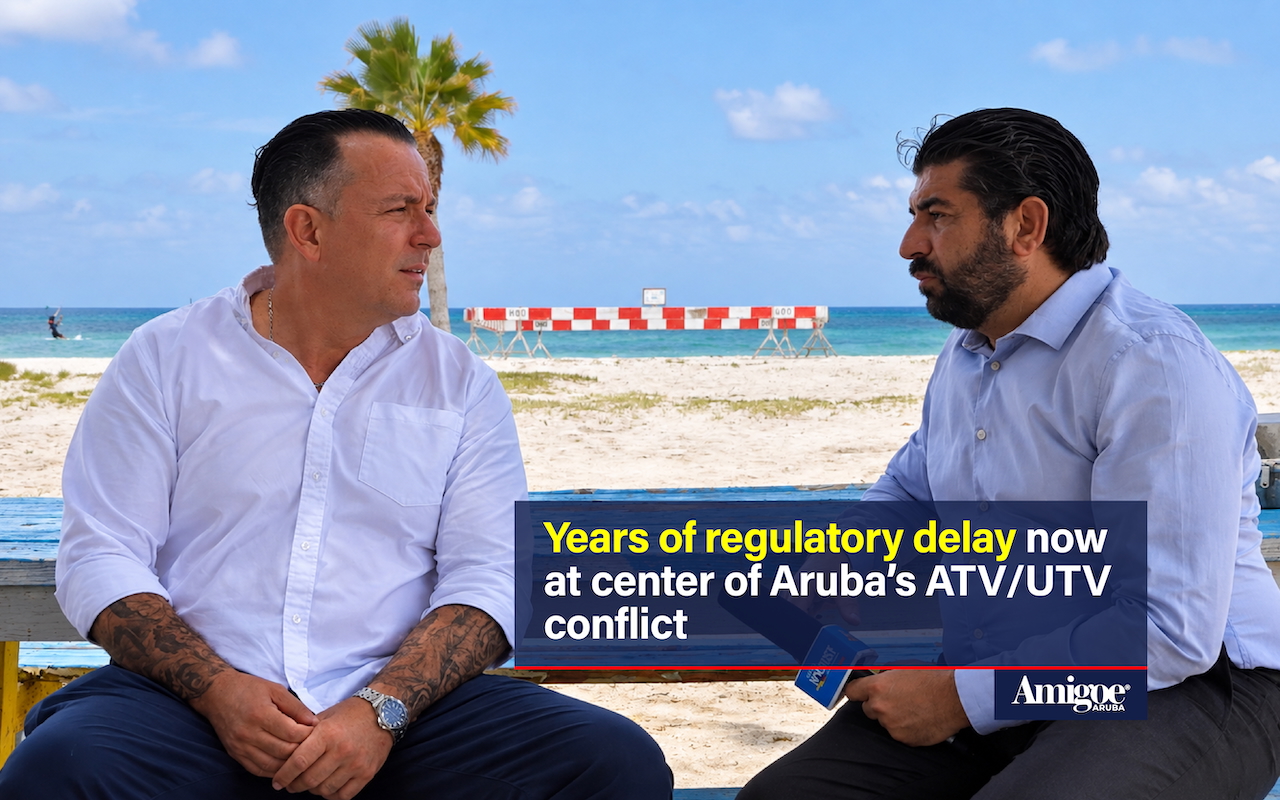
Tour operator Jimmy Douglas made essentially that argument during an interview with Amigoe Aruba. He said operators support preserving nature but also want employment and the tourism product protected. He acknowledged that reform of the sector may be necessary, while arguing against ending the activity altogether.
Court has now forced the discussion
The issue has reached the point where the judiciary has effectively created a window for government, conservationists and the tourism sector to find a workable arrangement.
On September 9, Judge A.H.M. van de Leur postponed the north-coast case for five weeks. The Court recognized the different interests involved: ABC’s interest in protecting legally designated natural areas, the operators’ interest in continuing activities that have been tolerated for years, and the Government’s responsibility to consider both nature protection and the broader Aruban interest.
Government subsequently began formal discussions with ABC, while it also signed a protocol with several tour operators. Topics identified for further negotiation include designated routes, controlled access, zoning, supervision, noise restrictions, enforcement and sanctions.
Again, many of these concepts closely resemble proposals that existed years ago.
The wider land-management question
The conflict also occurs against the background of Aruba’s broader spatial-planning debate.
On August 19, Government formally extended the existing ROPV through 2029, maintaining the rules governing the designation, development and use of land. Critics, including representatives of the Rainbow Warriors Foundation and the opposition MEP, have questioned aspects of the extension process and consultation surrounding spatial planning. Those are attributed criticisms rather than established findings that the extension itself was unlawful.
For the ATV/UTV controversy, however, the practical issue remains the same regardless of that political debate: Aruba needs clarity over where vehicles may go, under what conditions, who is authorized to operate, how violations will be detected and who will enforce the rules.
A problem that did not start in 2026
The evidence increasingly points to a regulatory problem accumulated over many years rather than a conflict created by one organization, one company or one recent government decision.
Conservationists have been demanding protection for years. The tourism sector documented its willingness to accept regulation years ago. ATA says designated routes were recommended more than a decade ago.
Yet Aruba entered 2026 without the comprehensive system capable of reconciling those interests.
The five-week period granted by the Court is therefore about more than resolving one lawsuit. It is an opportunity to finally answer a question Aruba has postponed for years: how can the island protect its natural heritage while providing clear, enforceable rules for a tourism activity that has become an established part of its visitor economy?