



© 2025 Aruba Intelligence - Quantum Quorum Media

ARUBA TOURIST CHANNEL
Your opinion matters
Share your view and help shape visitor experiences in Aruba.
Take the surveyARUBA TOURIST CHANNEL
Share your view and help shape visitor experiences in Aruba.
Take the survey

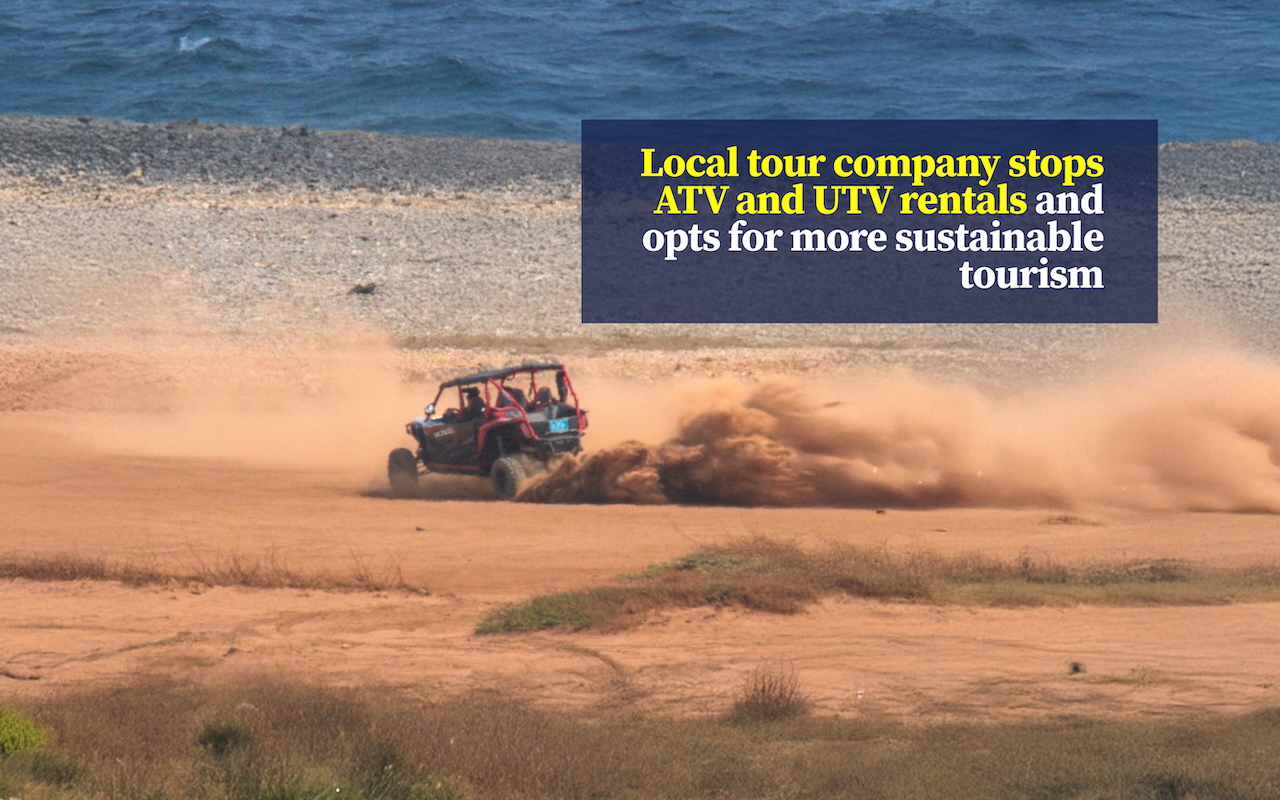
Oranjestad – The Aruban tour company Around Aruba has decided to stop renting out all-terrain vehicles (ATVs) and utility task vehicles (UTVs). According to owner Philips, this decision is driven by concerns over safety, environmental protection, and the increasing pressure on the island. The company will now focus exclusively on guided tours as an alternative.
In a conversation with Around Aruba, Philips stated that the decision stems from a broader sense of responsibility. “We see that the use of these vehicles poses risks, both for visitors and for nature. As a company, we no longer want to contribute to that,” he said.
According to him, guided tours offer a more controlled and safer way to explore the island, with greater respect for the environment and better compliance with existing regulations.
The decision by Around Aruba aligns with a growing debate surrounding the use of ATVs and UTVs. Both traffic safety and environmental damage are being cited as key concerns.
Philips specifically highlighted the issue of speed and technical control. “There is no need for vehicles that can reach extremely high speeds. That only increases the risks,” he stated. He advocates for the government to set clear limits and enforce stricter compliance.
In addition, technological solutions such as geofencing are being discussed, whereby vehicles are automatically restricted to predefined zones in order to protect sensitive natural areas.
Public responses to the issue show a wide range of opinions, including several concrete proposals.
Some comments call for stricter regulation rather than a complete ban. One user stated: “Too many companies doing tours and rentals at the same time. Stop giving permits to more companies, allow only a certain amount.” This reflects concerns about the number of operators in the market.
Technological solutions are also mentioned. Another user wrote: “They should be regulated, geo-fenced and fined automatically.” This aligns with proposals to strengthen enforcement through digital monitoring systems.
There is also support for guided-tour-only models. As one user noted: “A lot of regulation, some type of enforcement and only trusted companies that have proven to care about the environment.” This suggests a system limited to certified and controlled operators.
A more moderate position advocates structured use rather than prohibition: “Control and give specific areas for using them.”
Concerns about road safety are also raised. One comment noted that groups of vehicles are “not respecting the roundabouts, creating a high accident risk,” calling for better integration with regular traffic.
Additional measures suggested include speed limits, restrictions on group sizes, and stricter technical inspections before vehicles are allowed on public roads.
Within this context, the decision by Around Aruba is seen by several observers as an example of responsible entrepreneurship. By voluntarily stepping away from a profitable activity, the company is choosing a model more aligned with sustainable tourism.
Aruba Tourist Channel expresses its appreciation for this move. The decision is viewed as a contribution to preserving the island’s natural quality and as a signal to the sector that alternative business models are possible.
The discussion surrounding ATV and UTV use touches on fundamental questions about the future of tourism in Aruba. The balance between economic development, environmental preservation, and livability remains central.
The decision by Around Aruba highlights that businesses within the sector can play an active role in this transition. Whether this approach will be followed more broadly will depend in part on future policy decisions and the extent to which regulation and enforcement are strengthened.