



© 2025 Aruba Intelligence - Quantum Quorum Media

ARUBA TOURIST CHANNEL
Your opinion matters
Share your view and help shape visitor experiences in Aruba.
Take the surveyARUBA TOURIST CHANNEL
Share your view and help shape visitor experiences in Aruba.
Take the survey

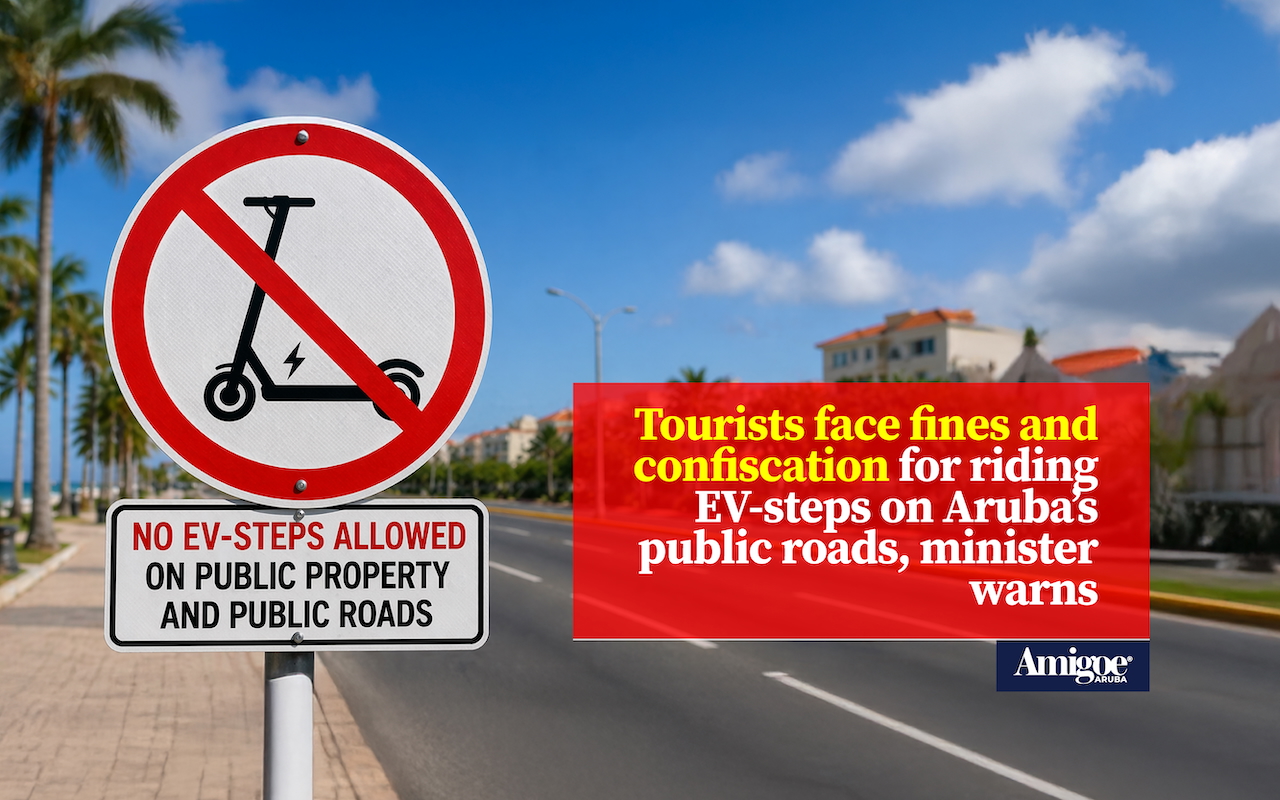
The Minister of Justice announced today that there is currently no legal basis to permit the use of EV-steps on public roads in Aruba. As a result, the use of such vehicles in public spaces is not allowed under existing law.
According to the minister, the issue stems from the classification of EV-steps as motorized vehicles. Under current legislation, vehicles in this category require specific regulatory frameworks, approval procedures, and enforcement mechanisms. These frameworks have not been established for EV-steps, making it legally impossible to issue permits.
The minister further stated that transport authorities do not have the legal authority to regulate or approve EV-steps for use on public roads or other public areas. Until legislation is amended, no form of legalization is possible.
He emphasized that enforcement will be active. Individuals, including tourists, who are found using EV-steps on public roads risk being fined. In addition, police may confiscate the vehicle. The minister indicated that these measures are a direct consequence of the current legal framework, which does not allow such use.
It was clarified that EV-steps may still be used on private property, where public traffic laws do not apply.
Legal context
The core issue lies in the absence of a defined legal category for light electric vehicles. In many jurisdictions, EV-steps are regulated separately, with rules governing speed, insurance, age limits, and road usage. In Aruba, no such framework exists, meaning existing definitions for motorized traffic apply by default.
This regulatory gap also raises broader questions about other forms of mobility, including bicycles. While bicycles are present in daily traffic, the extent to which infrastructure and legal provisions fully accommodate them is not uniformly defined across all road types. This reflects a wider structural issue in mobility policy.
Broader implications
The minister’s statement highlights an ongoing policy challenge: balancing innovation in mobility with road safety and legal certainty. EV-steps are already visible in Aruba, often operated by commercial providers, but their legal status remains undefined.
The announcement of active enforcement signals a restrictive approach by authorities in the absence of legislation. This may have direct implications for both users and businesses operating in this space.
No timeline was provided for potential legal reforms. Until such changes are enacted, the use of EV-steps on public roads remains prohibited.