

© 2025 Aruba Intelligence - Quantum Quorum Media


As travel costs rise, Aruba businesses need smarter ways to reach tourists
ORANJESTAD — The sudden shutdown of Spirit Airlines is more than an aviation story. For Aruba, it is a reminder that the tourism economy can change quickly, and that local businesses cannot depend only on traditional advertising, walk-in traffic or fixed travel patterns. When a low-cost airline disappears from the market, the immediate effect is felt by travelers. The longer-term effect can be felt by restaurants, tour operators, taxis, attractions, wellness providers and other businesses that depend on tourists making spending decisions while already on the island.
Spirit Airlines has ceased operations after 34 years, according to Associated Press. U.S. authorities and several major airlines have announced temporary relief measures, including capped or reduced fares for affected Spirit passengers. But those measures are short-term. The larger issue for destinations such as Aruba is whether air travel from the United States becomes more expensive and whether price-sensitive visitors begin adjusting their plans.
For Aruba, the numbers show why this matters. The Aruba Tourism Authority reported 427,343 stay-over arrivals through March 2026, an increase of 8.9 percent compared to the same period in 2025. North America remained the dominant market, with 328,967 arrivals, or 77 percent of all stay-over visitors. The United States alone accounted for 297,874 visitors, nearly 70 percent of Aruba’s total stay-over arrivals.
That dependence makes visibility inside the tourist decision journey more important than ever.
Spirit was small, but the signal is large
Spirit Airlines was not Aruba’s largest carrier. According to ATA data, Spirit brought 6,877 visitors to Aruba through March 2026, compared with 5,784 during the same period in 2025. That was an increase of 18.9 percent, but still only a small share of total arrivals.
The strategic issue is not only volume. Spirit represented low-cost access. Its disappearance can reduce price pressure in the market and make travel to Aruba more expensive for some visitors. The ATA data also shows that Fort Lauderdale, one of Spirit’s key gateways, was growing sharply for Aruba: 10,377 arrivals through March 2026, up 75.4 percent from the previous year.
If ticket prices rise, some tourists may still come to Aruba, but they may arrive with a different spending mindset. They may compare more, book later, search more carefully and make fewer spontaneous purchases. That changes the commercial reality for local businesses.
The new problem: attention is harder to capture
Aruba’s tourism market is still strong. Cruise arrivals reached 376,442 through March 2026, up 12 percent, while the combined total of stay-over and cruise visitors reached more than 803,000 people in the first quarter.
But more visitors do not automatically mean more customers for every business. A tourist can be on the island and still never discover a restaurant, tour, taxi service, spa, shop or attraction. In a crowded digital market, visibility at the exact moment of decision is becoming more valuable than visibility in general.
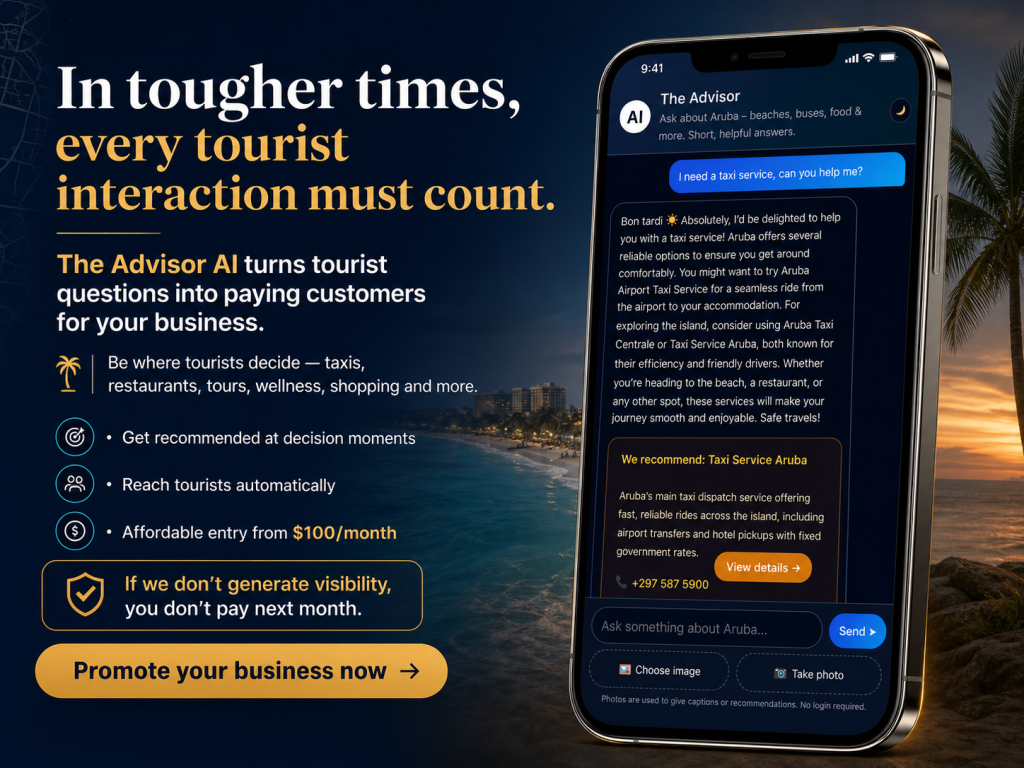
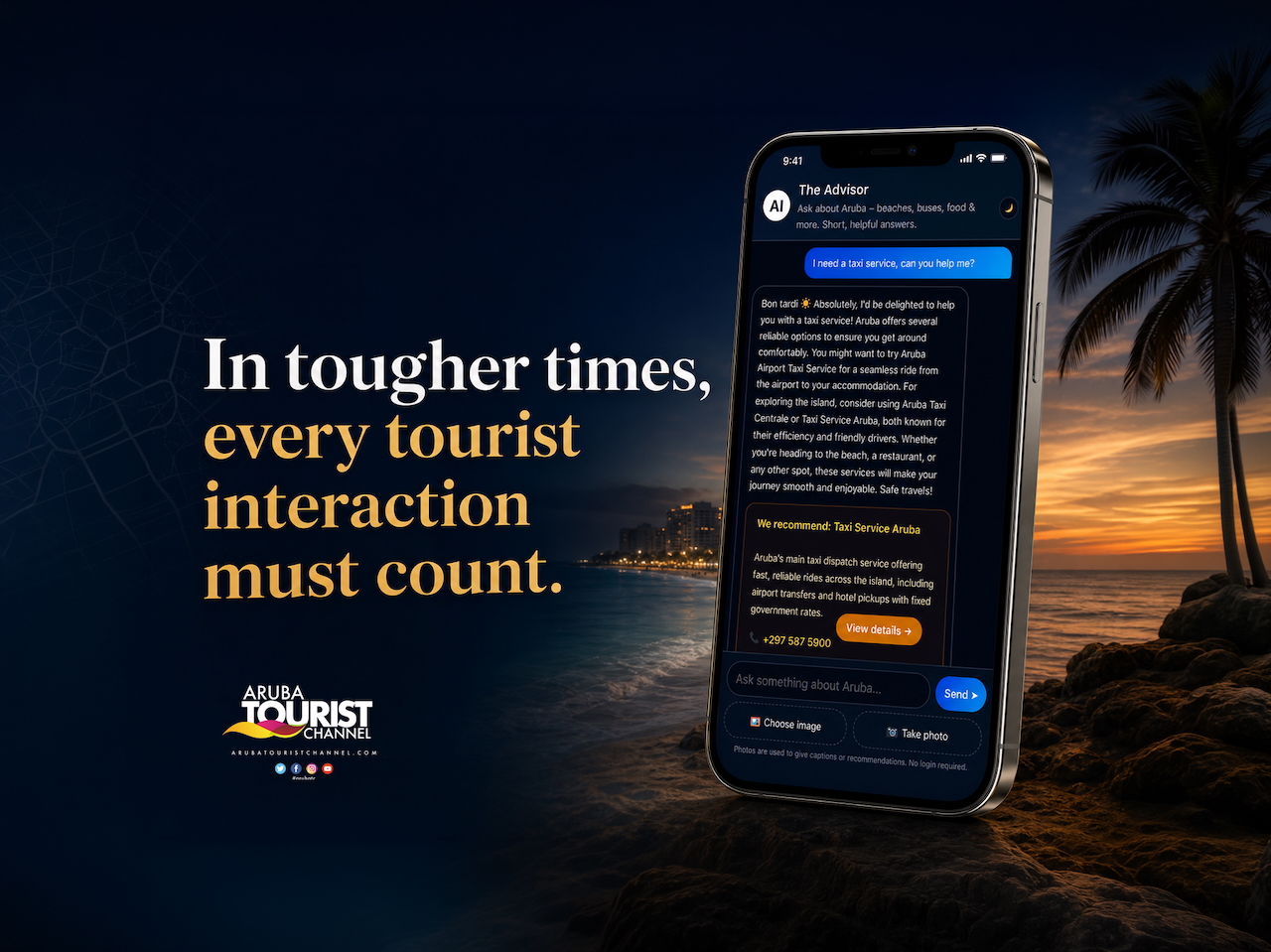
That is where Aruba Tourist Channel and The Advisor AI are positioning a new marketing advisory model: not as traditional advertising, but as an intelligent recommendation system designed to connect tourist questions directly with local business offers.
The core proposition is simple:
Turn tourists into paying customers automatically.
From advertising to decision-moment marketing
Traditional advertising asks a business to pay for exposure and hope the right customer sees it. The Advisor AI is built around a different model: tourists ask questions, the system understands intent, and approved partners can appear when their service is relevant.
For hotels, the value is not simply visibility. It is the ability to increase guest spending beyond the room. For tours, it is access to tourists already searching for activities. For restaurants, it is presence at the moment a visitor asks where to eat. For taxis and transport providers, it is the ability to capture movement demand when the tourist is ready to go somewhere.
This is not selling “AI” as a technical product. It is selling access to a controlled tourist-intent ecosystem.
That distinction matters in a tougher market. When travel costs rise, businesses need marketing that is closer to measurable demand, not broad campaigns that may or may not convert.
A lower-cost option for a more uncertain period
The proposed entry model for The Advisor AI is designed for affordability: starting at 100 dollars per month for placement inside the system, inclusion in the AI recommendation engine, smart keyword triggering, a tourist-facing business description and a clear call-to-action.
Premium placement can be structured for businesses that want priority visibility, with higher tiers depending on category, demand and exclusivity. But the entry-level offer is intentionally positioned as an economic tool for businesses that need visibility without committing to large advertising budgets.
A proposed guarantee makes the offer stronger:
If the system does not generate visibility, the business does not pay the next month.
That lowers the barrier for small and medium-sized businesses that may be cautious during a period of higher travel uncertainty.
Why this matters now
The ATA report shows growth among younger visitor groups. Gen Z visitors grew 18.6 percent through March 2026, while Gen A grew 15.3 percent. In March alone, Gen Z increased by 21.2 percent. These travelers are digital-first, mobile-first and highly likely to make decisions through search, chat, social platforms and recommendation tools rather than traditional brochures or static ads.
The Skift destination wedding excerpts included in the ATA report also identify affordability and accessibility as weaknesses for Aruba as a wedding destination. That is relevant beyond weddings. If Aruba is seen as expensive or less accessible, businesses must work harder to prove value at the moment the tourist is deciding where to spend.
The Advisor AI is therefore not only a marketing product. It is a response to a changed tourism environment.
A practical system for local businesses
The business model can be explained in direct terms:
For restaurants: “We bring tourists when they are deciding where to eat.”
For tour operators: “We send you ready-to-book tourists.”
For hotels and resorts: “We help increase guest spending beyond the room.”
For taxis and transport providers: “We capture transport demand when the tourist needs a ride.”
For wellness, beauty and medical-aesthetic providers: “We place your service inside the tourist’s discovery journey.”
The strength of the model is that it does not require a business to understand artificial intelligence. The business only needs to understand one question: will this system put my offer in front of tourists when they are ready to spend?
A controlled ecosystem, not random exposure
For Aruba, this matters because uncontrolled recommendation systems can promote businesses without local context, without verification and without commercial accountability. The Advisor AI can be positioned differently: a curated system where approved local partners are presented in a structured way, with descriptions, contact points, booking links and category triggers.
That creates value for both sides. Tourists receive faster guidance. Businesses receive more relevant visibility. Aruba Tourist Channel strengthens its position as a digital tourism platform. Aruba Intelligence provides the AI layer behind the system.
In uncertain times, that combination becomes more important.
The commercial message
The Spirit Airlines situation shows how quickly external shocks can affect the tourism chain. Airlines, fuel prices, ticket costs and route decisions are outside the control of most local businesses. But visibility, positioning and conversion are not.
The businesses that will be strongest in the next phase are not necessarily the ones spending the most on advertising. They are the ones closest to the tourist at the moment of decision.
That is the role The Advisor AI wants to occupy.
For Aruba’s local business community, the message is clear: tourism may remain strong, but the competition for tourist spending will become sharper. In that environment, an affordable AI-driven advisory and recommendation system is no longer a luxury. It becomes one of the most economic ways to stay visible, stay relevant and convert visitors into customers.