

© 2025 Aruba Intelligence - Quantum Quorum Media


Beyond overtourism: Aruba’s overflow from ATA’s winning tourism formula
Amigoe Aruba | Analysis
ORANJESTAD — Aruba’s tourism debate deserves a broader perspective than the label of overtourism alone. The pressure now visible on roads, housing, infrastructure, natural areas and public services is real. But it is also the consequence of something Aruba has spent decades trying to achieve: extraordinary international demand for the island.
That distinction is becoming increasingly important.
Rather than viewing Aruba’s present situation only as a failure caused by too many visitors, it can also be understood as an overflow from a tourism formula that has worked exceptionally well. The Aruba Tourism Authority (ATA) has played a central role in building that demand through international marketing, airline partnerships, destination development and the positioning of Aruba as one of the Caribbean’s strongest tourism brands.
Now ATA itself is acknowledging that the next phase can no longer be primarily about growth.
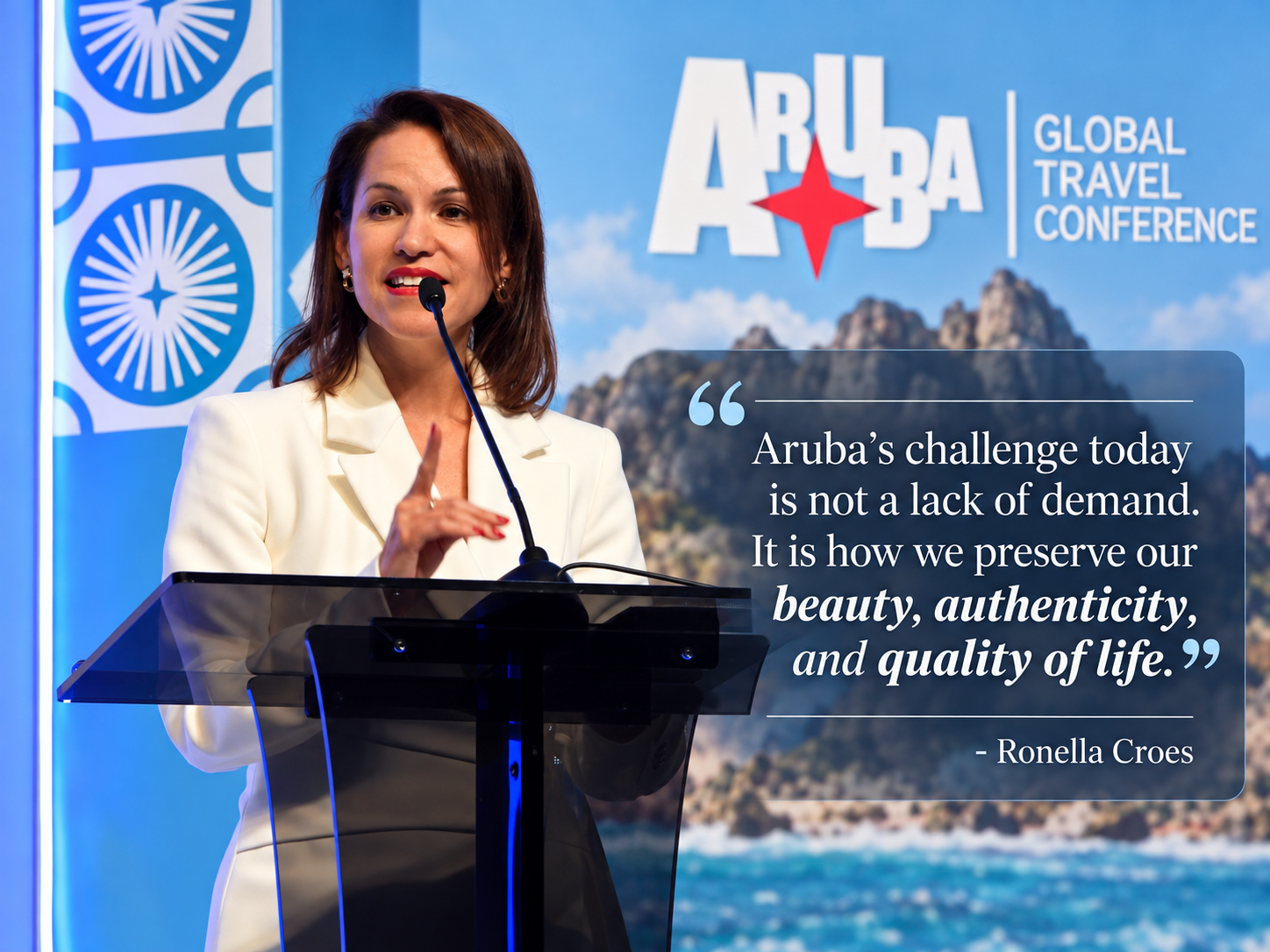
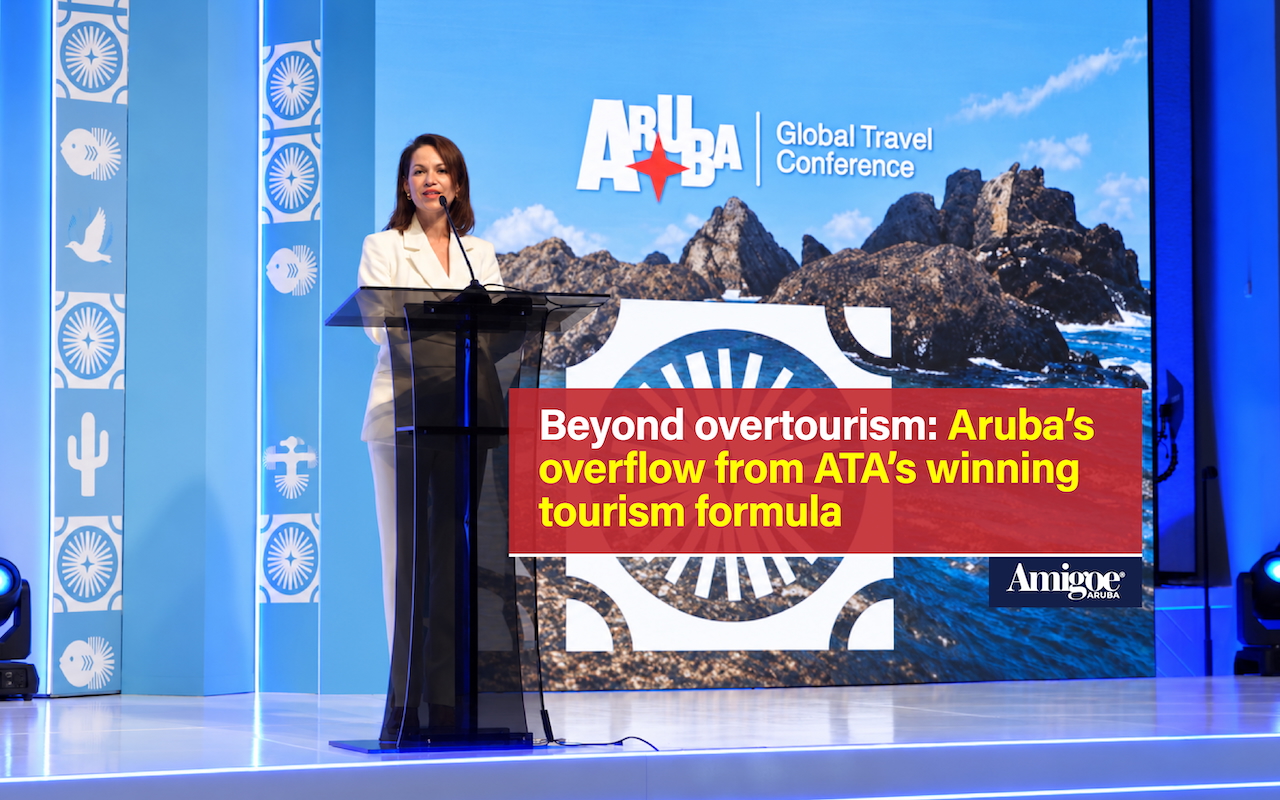
During the Aruba Global Travel Conference on September 15, 2026, ATA CEO Ronella Croes presented perhaps one of the clearest descriptions yet of that transition.
Looking back at Aruba’s economic transformation following the closure of the oil refinery in 1985, Croes described how unemployment had risen to approximately 35 percent and how Aruba subsequently embraced tourism as its economic path forward.
What began as an economic recovery strategy developed into the foundation of Aruba’s modern economy.
Four decades later, according to figures cited by Croes from the World Travel & Tourism Council, Aruba is the second-most tourism-dependent nation in the world, with tourism contributing an estimated 76.5 percent of GDP in 2025 and a projected 78.6 percent in 2026.
That level of dependence illustrates both the extraordinary success and the vulnerability of Aruba’s tourism model.
Croes also openly recognized that the challenges surrounding tourism have changed.
Housing, mobility, infrastructure, natural resources and quality of life, she said, have now become central tourism issues.
That acknowledgement is important because it moves the discussion beyond the simplistic choice between being “for tourism” or “against tourism.”
Aruba’s challenge is no longer generating demand.
The challenge is managing the demand that the island has successfully created.
ATA moves away from volume
Perhaps the most important element of Croes’ address was ATA’s increasingly explicit move away from measuring tourism success principally through visitor numbers.
For 2027, ATA intends to pursue a limitation of growth in stayover arrivals to approximately 1.4 percent, while prioritizing higher-value visitors.
ATA also plans to increase Aruba’s share of affluent travelers from the United States, refine segmentation strategies in Latin America and Europe, expand premium airlift and increase spending from cruise passengers while simultaneously advocating for limits on cruise arrivals.
That is a significant policy signal.
It demonstrates that ATA itself recognizes that unlimited volume is not the objective.
The organization is instead moving toward a tourism economy where the question becomes not simply how many people Aruba can attract, but what economic, social and environmental value each visitor contributes.
Croes summarized that direction clearly: Aruba’s future cannot be defined by the short-term pursuit of arrivals.
This strengthens the argument that Aruba’s present tourism pressure should be examined as an overflow requiring management rather than merely as evidence that the tourism model itself has failed.
Vacation rentals also enter the equation
ATA’s strategy also extends beyond hotels and airlines.
Croes announced that the organization will continue advocating for a well-regulated and transparent short-term vacation-rental sector, intended to protect community interests while supporting a balanced tourism economy.
This is particularly relevant to the wider overtourism discussion.
Visitor pressure is no longer determined only by traditional hotel-room capacity. Short-term rentals have expanded the number of visitors who can stay within residential communities, creating additional implications for housing, traffic, neighborhood character and infrastructure.
Managing tourism therefore requires understanding the island’s true accommodation capacity rather than looking exclusively at hotel inventory.
From marketing organization to destination manager
ATA’s evolution is also institutional.
Croes emphasized that ATA operates not merely as a destination marketing organization but as a Destination Marketing and Management Organization.
That distinction matters.
ATA says it is now monitoring a broader range of indicators, including the quality of life of residents, the quality of the visitor experience, the quality of economic impact and the protection of Aruba’s natural and cultural assets.
If implemented transparently and supported by measurable indicators, this could substantially change how Aruba defines tourism performance.
Visitor arrivals and tourism revenue would remain important, but they would no longer be sufficient by themselves to declare a successful year.
A record year in arrivals accompanied by deteriorating infrastructure, environmental damage or declining resident satisfaction could no longer automatically be described as tourism success.
Visitors also receive responsibility
Another important development in Croes’ speech was the shift in responsibility toward the visitor.
For many years, tourism strategy centered on the question of what Aruba could provide to its guests.
Croes said the question must now also become:
What can our guests do to help us protect our island?
ATA’s international communication strategy reflects that philosophy through the message:
“When You Love Aruba, It Loves You Back.”
ATA also announced a new local business-to-guest communication strategy intended to carry responsible-tourism messaging directly to visitors while they are on the island.
According to research commissioned by ATA and cited by Croes, involving approximately 7,000 respondents internationally, 96 percent considered responsible tourism important, while 73 percent wanted to make a positive contribution to destinations they visit.
However, only 23 percent believed they had been shown how to do so.
Among luxury travelers, ATA’s research found that 34 percent considered positive impact part of what defines a premium travel experience.
That gap represents an opportunity for Aruba.
If visitors are willing to behave more responsibly but lack clear guidance, better communication, regulation and destination design can influence where they travel, what they do and how they interact with Aruba’s environment and communities.
Success and pressure can exist together
None of this means Aruba should ignore the consequences associated with tourism pressure.
Environmental degradation, road congestion, pressure on natural areas, housing concerns and conflicts over the use of limited space remain legitimate issues.
Success and excessive pressure can exist simultaneously.
That is precisely why describing Aruba’s situation solely as overtourism may not capture the complete picture.
Aruba has not reached this position because international interest collapsed or because destination marketing failed.
The opposite occurred.
The product became enormously successful.
The international brand became powerful.
Air connectivity expanded.
Visitor loyalty became exceptionally strong.
And the resulting demand began testing the physical and social capacity of a small island.
The solution therefore cannot simply be more promotion and more arrivals.
But neither does it require dismissing the tourism model that helped transform Aruba’s economy.
It requires managing its overflow.
The next test for ATA
ATA’s long-term vision now extends toward 2035, accompanied by a five-year roadmap and what Croes described as an ongoing recalibration of Aruba’s National Tourism Policy.
That next stage may ultimately become more important than the marketing success that preceded it.
ATA and government authorities will increasingly need to connect visitor strategy with roads, waste management, water, energy, housing, nature protection, law enforcement, accommodation policy and spatial planning.
These responsibilities do not belong to ATA alone.
Destination management requires cooperation between government ministries, ATA, businesses, tourism operators and residents.
And measurable targets will matter.
If Aruba limits stayover growth, regulates vacation rentals, manages cruise volumes, protects environmentally sensitive areas and succeeds in generating greater economic value from fewer additional visitors, the island may establish a tourism model capable of remaining successful without continuously expanding volume.
Croes ended her address with a simple principle:
“Un Aruba dushi pa biba ta un Aruba dushi pa bishita.”
A wonderful Aruba to live in is a wonderful Aruba to visit.
That statement may ultimately provide the most useful benchmark for Aruba’s tourism policy.
ATA’s winning formula has already demonstrated that Aruba knows how to create international demand.
The next achievement must be proving that Aruba can manage that demand.
Tourism success in the coming decade should therefore not be measured primarily by how many more visitors can fit onto the island.
It should be measured by whether tourism produces stronger communities, better infrastructure, greater local prosperity, effective protection of nature and a quality of life that residents themselves can experience.
Aruba’s next tourism challenge is not creating success. It is managing the overflow of the success it has already created.