


© 2025 Aruba Intelligence - Quantum Quorum Media


Spirit’s exit affects Aruba mainly through affordable access to the U.S. market
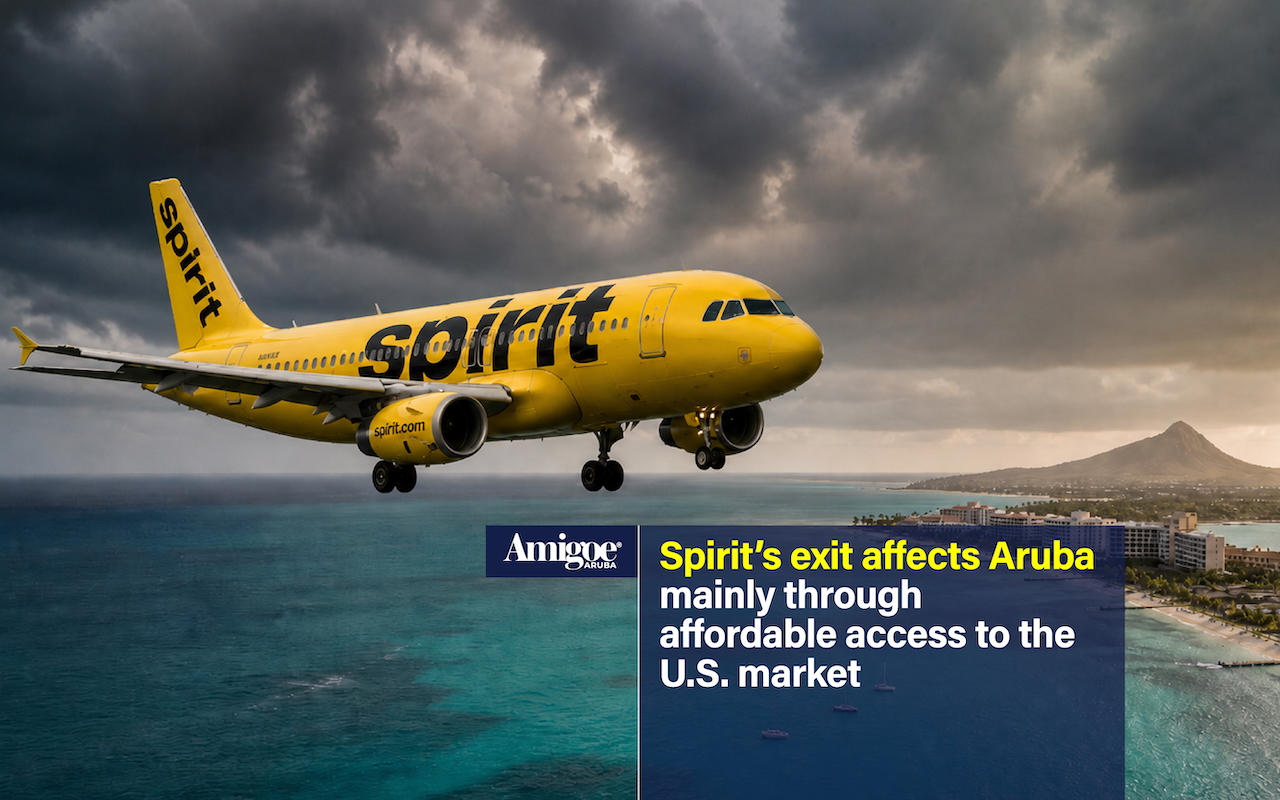
ORANJESTAD — The end of Spirit Airlines does not create an immediate crisis for Aruba’s air connectivity, but it does expose a vulnerability in the affordability of travel from the United States. According to figures from the Aruba Tourism Authority, Spirit accounted for 6,877 stay-over visitors to Aruba in the first quarter of 2026, an increase of 18.9 percent compared to the same period in 2025. This represented only about 1.6 percent of all stay-over arrivals, but it was an important part of the low-cost travel segment.
Spirit Airlines, long known as an ultra-low-cost carrier, has ended its operations after 34 years, according to Associated Press. The airline had been struggling with financial problems, earlier bankruptcy proceedings, high costs, and failed rescue attempts. Reuters reported shortly before the shutdown that talks over a possible 500 million dollar support package were still ongoing, but no final solution was reached.
Small Market Share, Significant Price Function
According to the ATA, Aruba recorded a total of 427,343 stay-over visitors through March 2026, an increase of 8.9 percent compared to 392,421 during the same period in 2025. North America remained by far the most important source market, with 328,967 visitors, or 77 percent of the total. The United States alone accounted for 297,874 visitors, nearly 70 percent of all stay-over arrivals.
Within that total, Spirit’s numerical share was limited. JetBlue brought 79,297 visitors during the same period, American Airlines 74,122, Delta 60,119, and United 59,868. Spirit followed with 6,877 visitors. Still, Spirit’s importance was greater than its market share suggests, because low-cost carriers do not only transport passengers; they also put pressure on ticket prices charged by other airlines.
For Aruba, that is crucial. The island is increasingly positioning itself as a premium destination, but it remains dependent on sufficient affordable access from the U.S. market. When a low-cost carrier disappears, travelers may still be able to fly with other airlines, but possibly at higher fares.
Fort Lauderdale as a Sensitive Point
The main vulnerability lies with Fort Lauderdale. ATA figures show that Fort Lauderdale accounted for 10,377 visitors to Aruba in the first quarter of 2026, an increase of 75.4 percent compared to 5,917 in 2025. In March alone, Fort Lauderdale rose to 4,604 visitors, almost 90 percent more than a year earlier.
Shortly before the shutdown, Spirit was still offering tickets between Fort Lauderdale and Oranjestad, with advertised one-way fares from roughly 94 to 107 dollars, depending on date and availability. This gave Spirit a clear role as a low-cost gateway between Florida and Aruba.
If other airlines do not fully replace this capacity, this segment could be affected in particular: travelers who reached Aruba cheaply through Fort Lauderdale or through Spirit’s broader U.S. network. The effect may then be visible not only in passenger numbers, but especially in the price perception of Aruba as a destination.
Possible Economic Exposure
Based on ATA data, the theoretical economic exposure can be estimated. ATA reports an average length of stay of 7.2 nights for the first quarter and refers in the CBA table to average daily tourist spending of 576 florins. Applying these figures to Spirit’s 6,877 passengers through March, this segment represents a maximum estimated tourism spending value of approximately 28.5 million florins on a quarterly basis.
That amount should not be interpreted as a direct forecasted loss. Some travelers will likely rebook through JetBlue, American, Delta, United, Southwest, or other airlines. However, the figure does show the approximate scale of the passenger value linked to this low-cost segment.
In March alone, Spirit carried 3,010 visitors to Aruba, compared with 2,398 in March 2025. That represented growth of 25.5 percent. This makes the shutdown notable: Spirit was small, but it was growing faster than the overall market.
Risk for Young Travelers, Families, and Group Travel
The impact may be felt most strongly among price-sensitive segments. ATA data shows strong growth among younger visitor groups. Gen Z grew by 18.6 percent in the first quarter, while Gen A grew by 15.3 percent. The 12-to-19 age group also grew by 20.4 percent. These segments often travel with families, groups, or budget-conscious bookings.
Affordable air access is also important for destination weddings and group travel. In the Skift study included by ATA, Aruba is positioned strongly on romance, safety, luxury, and unique venues, but weaker on affordability and accessibility. That weakness could become more pronounced if a low-cost carrier leaves the market.
The same Skift analysis indicates that destination weddings are economically valuable, but also sensitive to costs, accessibility, and competition from other Caribbean destinations. If airfares to Aruba become more expensive, this could influence final destination choices, especially for larger groups.
Not an Aviation Crisis, but a Strategic Warning Signal
Aruba remains strongly connected to the U.S. market. The major airlines remain dominant, and total arrival figures are positive. Stay-over arrivals increased by 8.9 percent, cruise arrivals by 12 percent, and the combined total of stay-over and cruise visitors reached 803,785 through March.
For that reason, Spirit’s disappearance is not an acute aviation crisis for Aruba. It is rather a strategic warning signal. Aruba’s tourism growth remains strong, but that growth depends heavily on North America, and especially the United States. When a low-cost carrier disappears, the market becomes more dependent on larger airlines with potentially higher fare structures.
Policy Question for Aruba
For Aruba, the policy question is now not only about replacing seats, but about protecting affordable accessibility. The island must continue to monitor whether other airlines take over capacity on Fort Lauderdale and similar routes, and at what prices.
The core impact is therefore clear: Spirit was not large enough to disrupt Aruba’s tourism market, but it was important enough to influence the affordability of U.S. access. In a market where Aruba is increasingly focusing on high-value tourism, the low-cost segment should not automatically be underestimated. It keeps the destination more broadly accessible, supports younger and price-sensitive travelers, and prevents Aruba from becoming dependent only on premium ticket prices.